Our Arklahoma Heritage: The "Grandma Moses of Texas" was born in Dyer and spent formative years in Johnson County
- Dennis McCaslin

- 20 hours ago
- 3 min read


Fannie Lou Bennett Spelce stands among the most celebrated American folk artists of the twentieth century, a memory painter whose vivid canvases preserved the images of rural Arkansas life long after she left the state.
Born Fannie Lou Bennett on June 19, 1908, to farmers Florence and Hillary Bennett in the small Crawford County community of Dyer, she grew up as the first member of her family to pursue education beyond high school. She shared a household with four siblings, and the family’s days revolved around farm work, church gatherings, and the excitement of local county fairs.

Those early scenes of Dyer, along with later years spent raising her own children in Clarksville, would become the enduring subjects of her art.
After finishing high school, she enrolled at Sparks Nursing School in Fort Smith and earned her credentials as a registered nurse. Seeking broader experience, she traveled to New York City, where she refined her skills in the city’s hospitals before returning to Arkansas.
On December 21, 1932, she married Neal Leslie Spelce Sr., a native of nearby Alma, in Muskogee. The couple had two sons, Neal Leslie Spelce Jr., born in 1936, and William Bennett Spelce. The marriage eventually ended in divorce, leaving Fannie Lou to raise the boys largely on her own while working as a nurse in hospitals across Arkansas, Oklahoma, California, and Texas.

At times the demands of shift work forced difficult choices; while employed in California she sometimes settled the boys in the family car outside the hospital rather than leave them alone at home.
The most formative stretch of her parenting years unfolded in Clarksville in Johnson County. There her sons attended grade school and high school, and the town’s streets, churches, and community events became the backdrop of their childhood.
Fannie Lou worked for Dr. Rex Siegel and at the Clarksville Municipal Hospital, balancing professional responsibilities with the daily realities of single motherhood. The landscapes, quilting bees, family prayer gatherings, and county fairgrounds of the Clarksville area sank deep into her memory.
Decades later those same images would fill her paintings with meticulous, affectionate detail, turning personal recollection into a lasting visual record of mid-century life in Johnson County.
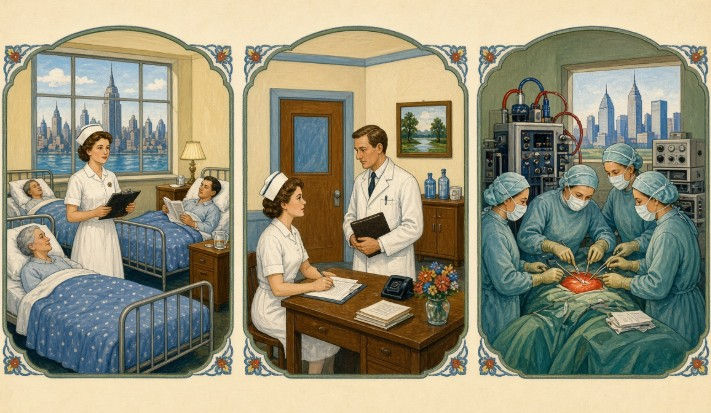
In the 1950s she relocated to Texas to remain near her sons as they attended the University of Texas. Her nursing career reached its height in Houston, where she served as the nurse in charge of the operating room at Methodist Hospital and assisted pioneering heart surgeons Michael DeBakey and Denton Cooley during the early era of open-heart surgery.
She later moved to Austin and took a position as school nurse at St. Stephen’s Episcopal School, a role that provided stability and free summers.
It was during one of those summers in 1966 that she enrolled in an oil painting class at the Laguna Gloria art museum. On the first day she managed only a small portion of the canvas.
Rather than erase and begin again under the instructor’s eye, she finished the work at home from memory. The teacher recognized an unusual gift and labeled her a “primitive” artist. Spelce replied with characteristic humor that she might be old, but she was not primitive.
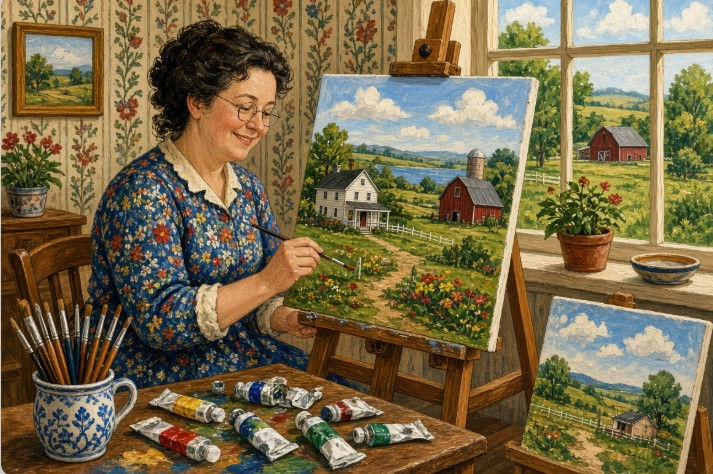
The instructor wisely advised her to paint whatever she wished and never take another formal lesson. That single exchange launched a second career that would last more than two decades.
Working entirely from recollection rather than direct observation, Spelce created densely detailed scenes of quilting bees, family prayers, county fairs, peach harvests, camp meetings, and the everyday life of Clarksville and Dyer.

Her best-known work, The Quilting Bee, required a full year; she used a magnifying glass and a brush with a single hair to render every thread of the curtains and every pattern in the quilts. Other celebrated paintings include Arkansas Peach Season and Camp Meeting at Maple Shade.
Estimates of her total output range as high as nearly five hundred works. Her sons recognized the quality of the paintings and introduced them to the New York art world. She exhibited in more than eighteen shows, including solo exhibitions at the Museum of American Folk Art, the Frank Miele Gallery, and the Kennedy Galleries, as well as the Blanton Museum in Austin and the Arkansas Arts Center in Little Rock.

Critics and collectors soon called her the Grandma Moses of Texas. Her work appeared in major books and periodicals devoted to American folk art and was featured in publications such as the Smithsonian and the Clarion.
Spelce continued painting into her later years while living in Austin. She died at her home there on April 11, 1998, at the age of eighty-nine.
Her remaining collection is cared for by her grandchildren, Cile Spelce Elley and Allen Bennett Spelce.
Through the luminous, painstaking images she left behind, the churches, fairs, family gatherings, and quiet streets of Johnson County and Dyer remain vividly alive.