Our Arklahoma Heritage: Sophia Lk-lo-ha-wah Pitchlynn - “She was a bridge between worlds...”


In a rural corner of McCurtain County, a weathered marble tombstone stands as a silent tribute to an extraordinary woman whose life was an integral part of the Choctaw National landscape and the political orgAnization of the tribe in Indian Territory.
Sophia Lk-lo-ha-wah Pitchlynn (1773–1871), a revered Choctaw matriarch, endured the upheaval of her people’s forced removal, raised a distinguished family, and left a lasting legacy that still flourishes--literally--in the yellow roses cherished by her descendants today.
Born on December 27, 1773, in Choctaw County, Mississippi, Sophia was the daughter of Ebenezer Folsom, an Anglo-American trader, and Natika, a Choctaw woman from the Iksa Hachotukni clan, which deeply influenced her identity.
Growing up in a matrilineal society where heritage and culture passed through the mother, Sophia embodied Choctaw traditions while adapting to a transforming world.

Her marriage to Major John Pitchlynn, a Scottish-American interpreter appointed by President George Washington, initiated a partnership that significantly influenced the Choctaw Nation’s future.
Together, Sophia and John raised ten children, merging Choctaw and Anglo-American heritages.
Among them, their son Peter Perkins Pitchlynn emerged as a notable figure, serving as Principal Chief of the Choctaw Nation (1864–1866). Peter was a dedicated advocate for education and tribal sovereignty, leveraging his education at the University of Nashville and his diplomatic skills to represent the Choctaw Nation in Washington, D.C.
His efforts included securing funds for tribal schools and negotiating with the U.S. government during the post-Civil War era, laying a foundation for future tribal governance.
Sophia also welcomed three stepchildren from John’s previous marriage, creating a home that harmonized cultural pride with adaptability.
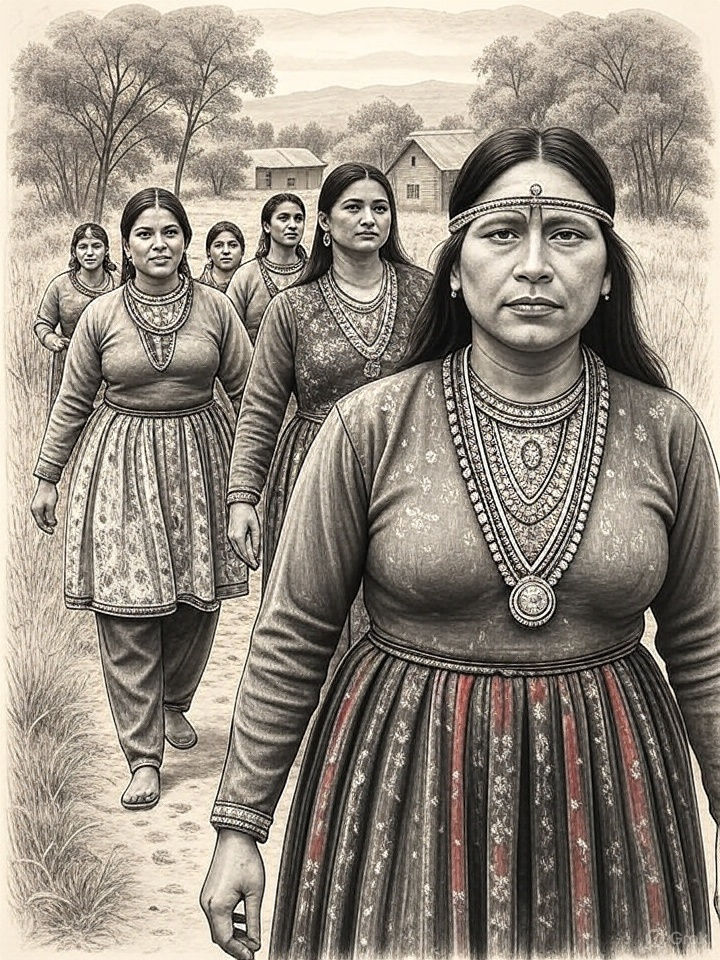
“She was the heart of the family,” notes Choctaw historian Dr. Clara Sue Kidwell, whose studies emphasize Sophia’s role in preserving clan traditions. “Her home was a sanctuary where Choctaw language and cuisine remained steadfast amid external changes.”
The 1830s brought profound disruption with the Treaty of Dancing Rabbit Creek, forcing the Choctaw from their Mississippi homelands to Indian Territory .
After John’s death in 1835, Sophia, in her sixties, undertook the grueling westward migration.
Settling near Tom, Oklahoma, she established a plantation along the Little River, managing it with fairness and skill that garnered widespread respect.Though fluent in English, Sophia preferred speaking Choctaw, serving traditional dishes like banaha and tanchi labona to her family and visitors.

Influenced by missionary Cyrus Byington, she embraced Christianity, integrating it into her cultural framework.Her plantation became a community focal point, and her love for botany left a lasting mark: yellow roses, transported from Mississippi, continue to bloom in her descendants’ gardens, symbolizing her journey.
Sophia’s later years reflected quiet grace. In 1859, at age 85, she drafted her will, naming sons Peter and Thomas as executors and ensuring her estate’s equitable distribution.She lived to 97, passing on December 18, 1871.
Her grave in the Garland Family Cemetery in McCurtain County, Oklahoma’s oldest marked burial site, is preserved by the Oklahoma Historical Society.
A wrought-iron fence surrounds it, and her tombstone simply reads: “Sophia, Wife of Major John Pitchlynn.”

Today, Sophia’s legacy endures in the Choctaw Nation’s cultural strength and her descendants’ accomplishments. Peter Pitchlynn’s diplomatic legacy, including his role in the 1866 treaty negotiations, bolstered tribal autonomy, while the family’s educational focus mirrors Sophia’s values.
“She was a bridge between worlds,” says Choctaw Nation Chief Gary Batton. “Her life shows how our ancestors preserved our culture against all odds.”
As visitors reflect at her gravesite or admire the roses tracing her path, Sophia Pitchlynn’s story imparts a profound lesson: strength lies in anchoring to one’s roots amid a changing world. In a time of turmoil, she nurtured not only a family but a legacy that continues to inspire.


