Our Arklahoma Heritage: On your way to Branson, you pass by and through a lot of history in the town of Alpena
- Dennis McCaslin

- 12 minutes ago
- 4 min read

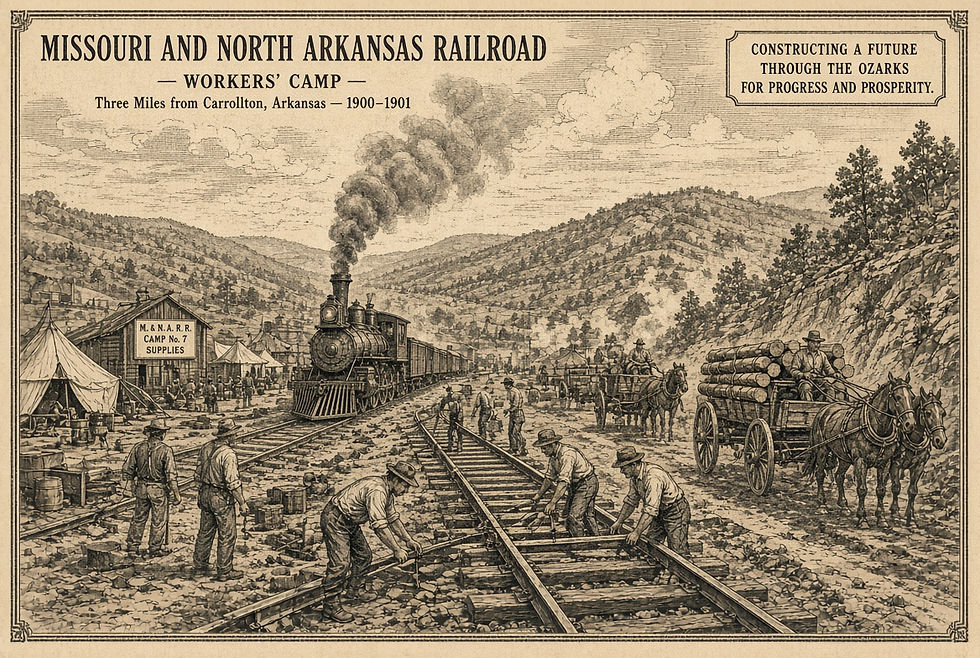
The community that would become Alpena began as a railroad workers’ camp in the opening years of the twentieth century, when the Missouri and North Arkansas Railroad laid its tracks three miles from the older settlement of Carrollton.
Local farmers cut timber for ties during the drought of 1901, and the camp soon drew merchants who dismantled buildings in the declining county seat and hauled them over to reassemble beside the new line.
The town was platted in November 1900. A post office opened in 1901 under the name Estes before it was redesignated Alpena Pass, a name attributed by some accounts to a railroad cook and by others to the alpine character of the surrounding terrain. Incorporation came on May 31, 1913, when the name was shortened to Alpena.
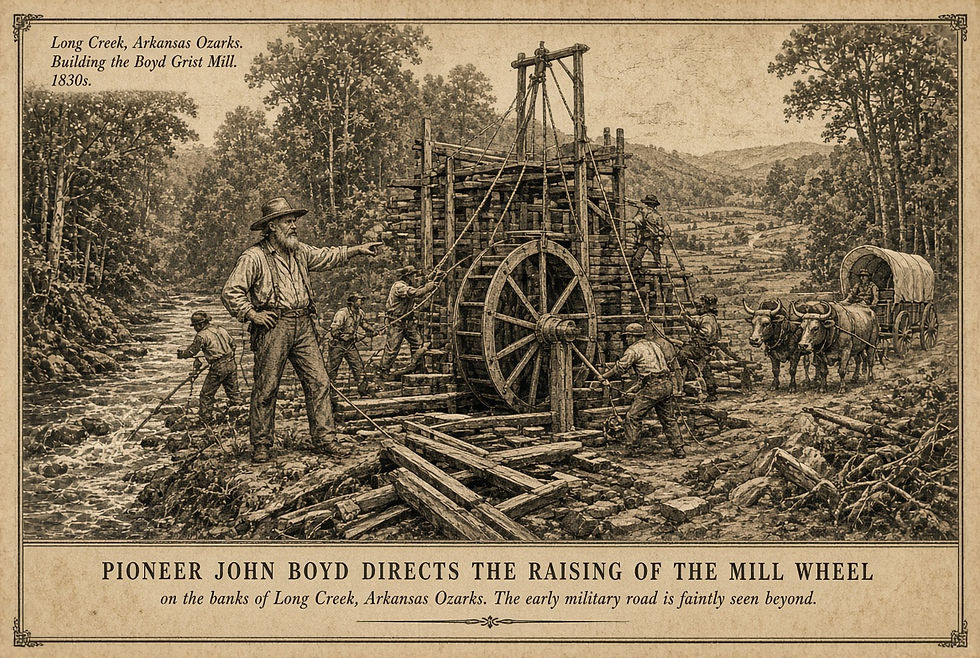
Earlier settlement had prepared the ground. The fertile bottomland along Long Creek first drew John Boyd, who received a formal land grant in 1849. Born before 1780 in North Carolina, Boyd had already lived in South Carolina, Georgia, Kentucky, and Indiana before reaching Arkansas.
He and his brothers Alexander and Bruce, along with brother-in-law Elijah Hulsey, moved from Crowley’s Ridge near Helena in 1832 and settled on Long Creek below Carrollton. Local tradition credits Boyd with driving the first team into what became Carroll County over the early military road.
Around 1836 he built a mill on the creek, one of the first in the vicinity. By the 1840 census he was listed as between sixty and seventy years old and sat on a grand jury in 1846. His land claim along the stream anchored a growing cluster of farms that would later form the nucleus of the Alpena community.
William J. Estes arrived in 1860 and took up land in the same stretch of bottomland. Little beyond the date of his coming is recorded in surviving county accounts, yet his presence marked the continued filling in of the Long Creek settlements in the decade before the Civil War.
He joined a neighborhood already shaped by the Boyds and other early families who raised livestock, cleared fields, and cut timber.
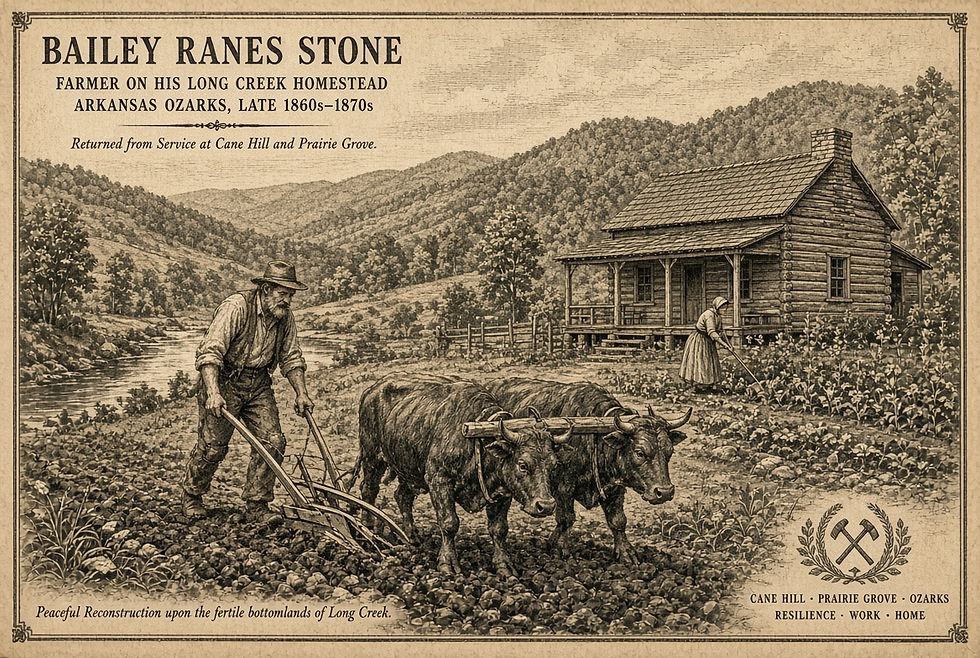
Bailey Stone followed in 1861. Born Bailey Ranes Stone in 1822 near Sparta in White County, Tennessee, he had married Dulcena Boyd in Carrollton in 1844, linking him directly to the Boyd family already established on Long Creek. A farmer by occupation, Stone lived in the Carrollton area through the 1850s and 1860s.
When war came, he enlisted as a private in Cocke’s Regiment of Arkansas Infantry, a Confederate unit that saw action at Cane Hill and Prairie Grove. After the conflict he continued farming and later secured a homestead patent. He died in 1892 in New Mexico, but his years on Long Creek helped solidify the small agricultural community that would, half a century later, give way to the railroad town of Alpena Pass.
Growth followed the rails. Within a short time, the settlement counted three general stores, two hotels, a drugstore, a poultry house, a livery stable, a lumber yard, two churches, a school with fifty pupils, three real estate agents, a restaurant, a barber shop, two blacksmith shops, a physician, a printing office, and an estimated population of 450.

By 1908, the list had grown to six general stores, a millinery shop, a bank organized the previous year, and a flour mill. A tomato canning factory opened in 1910. Robert Eddins published the Alpena Searchlight from 1905 to 1915. A sandstone quarry operated by 1914, and Carrie Nation lived briefly in the town in 1909.
By 1920, Alpena had become a timber and lumber shipping point and a trade center where farm goods from Boone and Carroll counties were loaded onto the trains. A sawmill and a hub-and-spoke factory stood among the industrial works.
Hard years tested the town.
The flood of 1927 sent Long Creek over its banks. The Great Depression closed the bank in 1931. Extension of U.S. Highway 62 in 1933 brought travelers and commerce independent of the rails. The Missouri and North Arkansas Railroad itself suffered repeated flooding and financial strain; operations ceased in the mid-1940s, and remaining segments ended service by 1961.
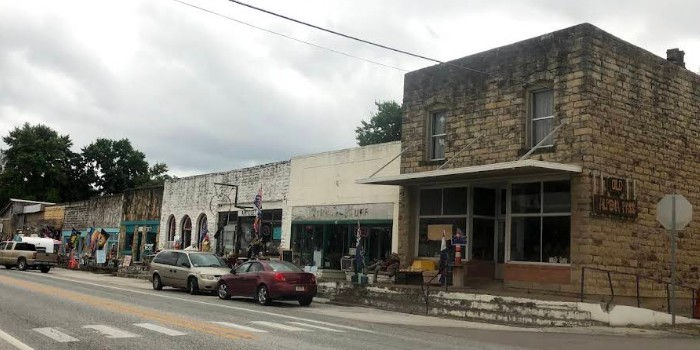
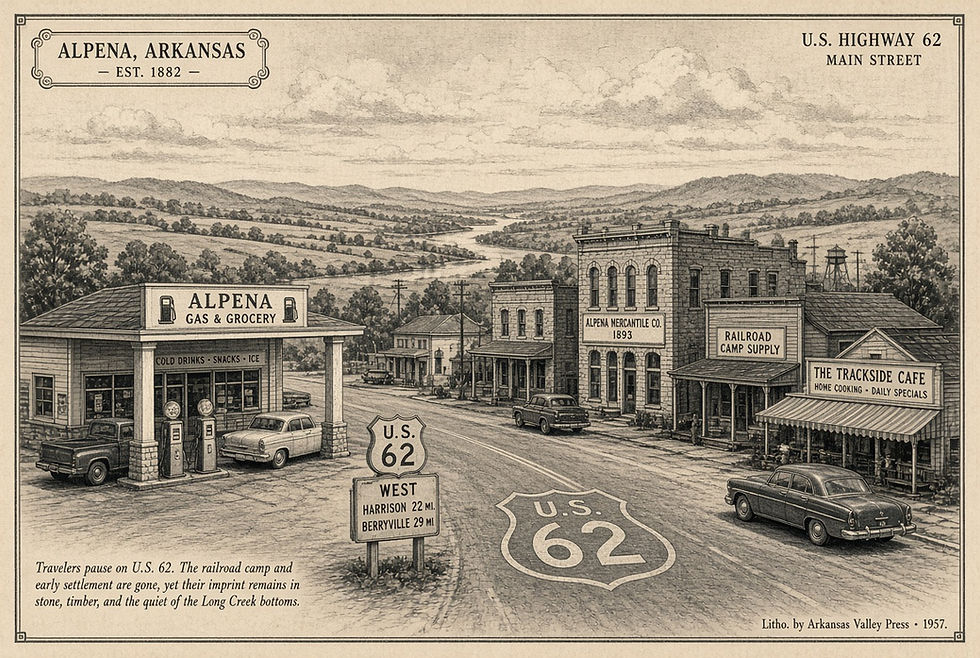
Alpena shifted its dependence to the highway that carried several thousand vehicles each day.
Today Alpena Pass is mostly known as a place to stop for gas, convenience store goodies or a quick bite at one of the local restaurants for folks on the road from the Fort Smith area to Branson, but the town still carries the imprint of the railroad camp that grew into a modest trade center more than a century ago.
Several thousand vehicles pass through each day on U.S. Highway 62, and the two dozen small businesses that remain, including service stations, eateries, auto shops and craft stores, depend on that steady flow of travelers.
The Alpena School District continues to anchor community life, and a handful of older stone buildings along Main Street stand as quiet reminders of the era when trains rather than automobiles defined the place.
Population hovers near 380, a figure that has held steady through decades of change.
The fertile bottoms along Long Creek that first drew John Boyd and the families who followed still lie just beyond the highway, while the memory of the Missouri and North Arkansas line, the canning factory and the early mills lingers in the landscape even as most motorists pause only long enough to refuel and move on.