our Arklahoma Heritage: On the field and in the ring Big Chief "Wahoo" was a dominate force for years
- Dennis McCaslin

- Apr 16, 2025
- 3 min read
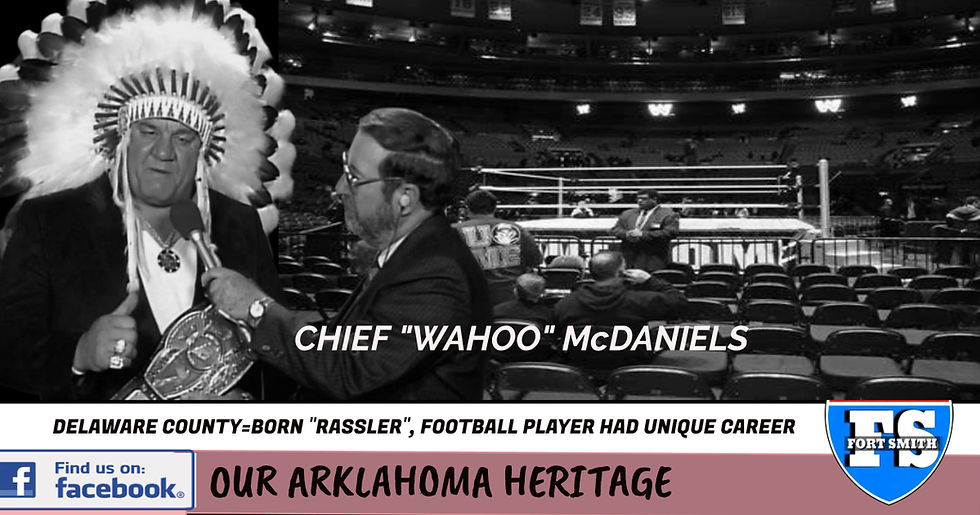

Edward “Wahoo” McDaniel was a force of nature.
Born on June 19, 1938, in Bernice, Delaware County, to Hugh Edward McDaniel and Phyliss Swagger McDaniel, he carried his Choctaw-Chickasaw heritage into a legacy that spans professional football and wrestling.
Known simply as “Wahoo” to fans who shouted his name from stadium seats and arena floors, he was a tomahawk-chopping, hard-hitting icon whose life matched the wild stories told about him.
McDaniel’s early years were shaped by the oil fields. His father, Hugh--nicknamed “Big Wahoo” for his love of fishing--worked as a welder, moving the family across the South as jobs demanded.

His mother, Phyllis, kept the household steady through the constant relocations, raising Wahoo and his siblings until the family settled in Midland, Texas.
There, young Ed emerged as an athlete at Midland High School, winning a state track title in shot put and playing baseball under a coach named George H.W. Bush, long before his White House days.
Football was where McDaniel truly stood out. Recruited by University of Oklahoma coach Bud Wilkinson, he starred for the Sooners, setting a still-standing school record with a 91-yard punt.
A Sigma Chi fraternity brother, he described himself as “robust, jolly, outspoken”--a polite way of saying he wasn’t always tame. In 1960, he joined the American Football League (AFL), launching a pro career with the Houston Oilers, Denver Broncos, New York Jets, and Miami Dolphins.

With the Jets, McDaniel became a fan favorite. His custom “Wahoo” jersey, stitched above the number 54, paired with his punishing tackles turned games into spectacles. The Shea Stadium announcer would call, “Tackle by… guess who?” and the crowd roared back, “Wahoo! Wahoo!”
Hall of Famer Len Dawson once said the hardest hit he ever took came from McDaniel’s relentless charge.
Football didn’t pay well in the ‘60s, so McDaniel moonlighted in professional wrestling, training under Dory Funk Sr. in Amarillo, Texas, during AFL off-seasons. What began as a side hustle turned into a calling.
Embracing his Native American roots--passed down from Hugh and Phyllis--with a feathered headdress and war paint, he debuted as “Chief” Wahoo McDaniel, a name coined by Vince McMahon Sr. in the World Wide Wrestling Federation (WWWF).

After hanging up his cleats in 1968, McDaniel went full-time in wrestling. His 1965 Madison Square Garden victory over Boris Malenko kicked off a career that would dominate the National Wrestling Alliance (NWA), American Wrestling Association (AWA), and beyond,
At 5’11” and 251 pounds, McDaniel was a brawler. His Tomahawk Chop--a brutal open-handed strike--left opponents’ chests bruised and red. Ric Flair once said, “You didn’t just feel a Wahoo chop. You remembered it for days.”
His rivalries were legendary. In Texas, he clashed with Johnny Valentine in matches so intense they spilled into Jim Crockett Promotions in the Mid-Atlantic, where Wahoo won the NWA United States Heavyweight Championship five times.
Valentine’s son, Greg, broke Wahoo’s leg in 1977 and sold “I Broke Wahoo’s Leg” T-shirts to gloat.

McDaniel faced off against Superstar Billy Graham, Harley Race, Roddy Piper, and Flair, wrestling in Florida, Georgia, Hawaii, and Japan. He claimed titles like the NWA Texas Heavyweight Championship and the AWA World Tag Team Championship with The Crusher, chasing the AWA World Title into the late ‘80s.
Outside the ring, McDaniel lived large. He partied with Joe Namath and Larry Csonka, golfed with Lee Trevino and Evel Knievel, and had a temper to match his persona.
Married five times to four women, he left behind two daughters, Nikki and Cindi, and a son. Yet friends like Flair and Magnum T.A. recall a generous man who mentored young wrestlers breaking into the business.
“Wahoo didn’t brag,” his wife Karen wrote in the 2022 biography Wahoo. “He showed you how great he was in the ring and left it there.” T

hat toughness hid a body breaking down. Diabetes and renal failure took their toll, ending his career in 1996 after years on the indie circuit. On April 18, 2002, he died in Houston at 63, awaiting a kidney transplant that never came.
He was cremated after his death and his ashes were "scattered to the wind".
Wahoo McDaniel’s name still carries weight. He’s in the WCW Hall of Fame (1995), Professional Wrestling Hall of Fame (2010), NWA Hall of Fame (2011), and WWE Hall of Fame’s Legacy Wing (2019).
A Native American trailblazer, he broke barriers and shaped wrestling’s future. His influence lives in every chop delivered and every crowd chant.
Wahoo was more than a wrestler or footballer. He was a warrior, a showman, a complex figure who lived full-throttle.
When the final bell rang, it didn’t end his story--it cemented a legacy that endures.


