Our Arklahoma Heritage: Major League All Star catcher had deep family roots in Northwest Arkansas
- Dennis McCaslin

- May 20, 2025
- 3 min read
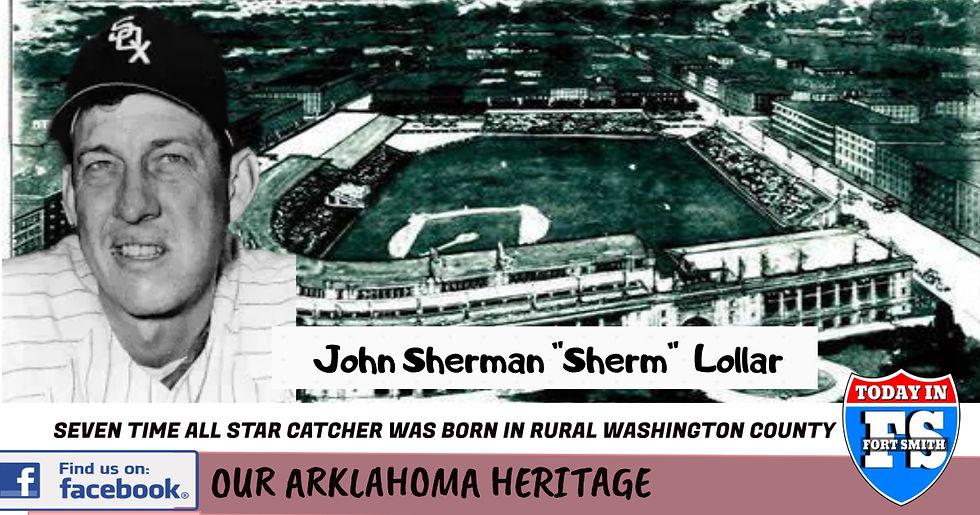


John Sherman “Sherm” Lollar Jr. was a baseball stalwart whose 18-year Major League career as a catcher left an impression on the sport, earning him seven All-Star selections and a reputation as one of the game’s finest defensive backstops.
Born , in the small Ozark community of Durham in Washington County, Lollar’s journey from rural roots to the bright lights of Chicago’s Comiskey Park is a story of talent, grit, and quiet determination.
Sherm Lollar was born in Durham, a tiny unincorporated settlement in Washington County, on August 23, 1924, The area, known for its scenic beauty and tight-knit communities, was home to his parents, John Sherman Lollar Sr. and Ruby Springfield Lollar.
When Sherm was three, the family relocated to nearby Fayetteville, the county seat, where John Sr. operated a grocery store. Life changed dramatically when Sherm was eight; his father died during surgery, leaving Ruby to support four children--Sherm, the eldest, followed by Kevin, Don, and Shirley.

Ruby sold the store and took a job at a Veterans Administration nursing home in Fayetteville, while Sherm assumed early responsibilities as the family’s steady hand.
Washington County shaped Lollar’s early years. Fayetteville, with its growing population and proximity to the University of Arkansas, offered a slightly broader stage than rural Durham. Though Fayetteville High School lacked a baseball team, Sherm’s passion for the game ignited at age 12 when he served as a batboy for the Fayetteville Bears of the Arkansas-Missouri League.
Local sandlot games honed his skills, laying the foundation for a career that would take him far beyond the Ozarks.

Lollar’s professional baseball career began in 1943 when he signed with the Baltimore Orioles of the International League at age 18. After a standout 1945 season--batting .364 with 34 home runs and earning MVP honors--he debuted with the Cleveland Indians on April 20, 1946.
Initially overshadowed by catchers Frankie Hayes and Jim Hegan, Lollar’s persistence led him to the New York Yankees in 1947, where he competed with Yogi Berra. His World Series performance that year--3-for-4 with two doubles against the Brooklyn Dodgers--showcased his potential, but Berra’s emergence prompted a trade to the St. Louis Browns in 1948.
Lollar’s defining chapter came with the Chicago White Sox, where he played from 1952 to 1963. As the anchor of the “Go-Go” Sox--a team built on speed and defense alongside stars like Nellie Fox and Luis Aparicio--he excelled.
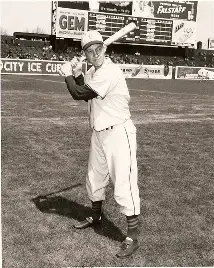
His best offensive year was 1959, when he hit .265, smashed 22 home runs, and drove in 84 runs, helping the Sox win the American League pennant. Behind the plate, Lollar was peerless, earning the inaugural Rawlings Gold Glove Award for catchers in 1957 and adding two more in 1958 and 1959.
His .992 career fielding percentage ranks among the highest ever, and in 1954, he famously threw out all 18 base stealers after May 25. A seven-time All-Star (1950, 1954-1956, 1958-1960), Lollar’s career totals--1,415 hits, 155 home runs, and a .264 average--cemented his legacy, earning him a spot on the White Sox All-Century Team in 2000.
Lollar retired as a player after the 1963 season at age 39, but his love for the game kept him in its orbit. On November 27, 1963, he joined the Baltimore Orioles as a bullpen coach, contributing to their 1966 World Series title before parting ways after the 1967 season.

In 1968, he coached with the Oakland Athletics, then transitioned to managing in the minors.
He led the A’s affiliates, the Iowa Oaks (1970-1972) and Tucson Toros (1973-1974), until a reported dispute with A’s owner Charley Finley ended his tenure.
Settling in Springfield, Missouri--roughly 100 miles north of Washington County--Lollar embraced a simpler life. He ran a bowling alley and refereed high school basketball games, living quietly with his wife, Connie Mattard, whom he married in 1949 after meeting her in Baltimore.
The couple raised one son, Sherman III, nicknamed “Shermie.” This period marked a return to roots reminiscent of his Arkansas upbringing, blending community involvement with family life.
Sherm Lollar’s life ended prematurely on September 24, 1977, at age 53, after a prolonged battle with cancer. He passed away in Springfield where he had built his post-baseball life.
Lollar was laid to rest in Rivermonte Memorial Gardens in Springfield, a peaceful cemetery that reflects the understated dignity he carried throughout his career.
His grave lies beside Connie’s, who survived him, and near their son Shermie, symbolizing the family unity that grounded him.