Our Arklahoma Heritage: Madison County-born musician and engineer innovated guitar industry practices
- Dennis McCaslin

- Apr 4
- 4 min read


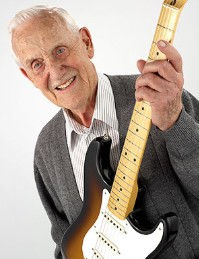
If you have ever played an electric guitar, George William Fullerton deserves credit for helping put it in your hands. Born on March 7, 1923, in Hindsville, Arkansas, he grew up in a household filled with music, where every family member played or sang.
His father, Fred, worked as a woodworker who also painted in oils and wrote poetry. In 1940, at age seventeen, Fullerton moved with relatives to Southern California and settled in the town of Fullerton in Orange County. After the move, he took a series of jobs to support himself. He drove a truck for a moving company, repaired radios part-time, and worked as a machinist.
He also continued playing guitar and bass in local bands on evenings and weekends. Those early experiences in woodworking, metalworking, electronics, and live music would shape the practical engineering approach he brought to the guitar industry.

Fullerton enlisted in the United States Marine Corps during World War II. He served as a machinist, gaining extensive hands-on experience shaping metal parts under the intense demands of wartime production. After his discharge, he returned to civilian work and took a machinist position at Consolidated Aircraft Company in California.
While employed there, he attended night classes at Fullerton Junior College to study electronics. He balanced these studies with his day job and continued performing music in local bands. The combination of military machining skills, aircraft industry precision work, formal electronics training, and practical experience repairing instruments laid the foundation for his later contributions to guitar manufacturing.

Fullerton was one of six children raised in Hindsville. His father, Fred, worked as a woodworker who produced oil paintings and kept manuscripts of poetry stacked throughout the home. The family possessed what his son later described as a “music gene,” with every member participating in some form of playing or singing.
Fullerton first encountered Leo Fender at outdoor park concerts where Fender supplied public address systems for local musicians. Their conversations about electronics and instrument repair led to a job offer.
On February 28, 1948, Fullerton joined the small operation at Fender Electric Instrument Manufacturing Company as a full-time employee. His initial assignments involved amplifier repairs and warranty service on steel guitars. Within months he shifted to guitar production, assisting Fender in turning prototype ideas into repeatable factory processes.

He fabricated specialized tools, including a machine that threaded guitar necks and a neck shaper that allowed consistent shaping of maple necks at scale. When the company introduced its first solid-body Spanish electric guitar (—the Esquire and Broadcaster models) in 1950, Fullerton oversaw the transition to mass production. He collaborated on solutions such as routing a channel into the back of the maple neck, installing a rigid steel truss rod, and covering it with a walnut strip, a method his father, Fred, helped refine during early runs
These techniques enabled the instruments, later renamed the Telecaster, to leave the factory in volume without warping or setup issues. Fullerton contributed to the Precision Bass launched in 1951, establishing the thirty-four-inch scale length that became an industry standard.

He also worked on the Stratocaster introduced in 1954, developing practical implementations for features including the teardrop-shaped output jack and the three-bolt neck adjustment system, for which he received patent credit.
Fullerton remained with Fender through its growth to a six-hundred-employee operation and its 1965 sale to CBS Musical Instruments, continuing until 1970. He then joined Leo Fender at Music Man for a short period before partnering with Fender and Dale Hyatt in 1980 to establish G & L Musical Instruments under CLF Research.
At the new company, they refined earlier designs, incorporating improved pickups, bridges, and hardware while maintaining the same emphasis on functional production engineering.
Fullerton sold his interest in G & L in 1986 yet stayed active in the industry. In 2007 he served as a consultant for the Fender Custom Shop, which released a limited-edition George Fullerton fiftieth-anniversary 1957 Stratocaster model along with a matching Pro Junior amplifier to mark his contributions.
He married Lucille Smith i 1945 and raised a family in the Fullerton area, maintaining a household centered on music and technical pursuits. His wife supported his work through the long factory hours and frequent prototype testing at home. They had two children, a daughter named Dianne and a son named Geoff, who later spoke publicly about his father’s quiet competence.
Two grandchildren completed the immediate family.

Fullerton received recognition for his engineering achievements through industry tributes and the 2007 Fender anniversary models that carried his name. Historians and former colleagues consistently credit him with the practical innovations that turned Leo Fender’s concepts into reliable mass-produced instruments rather than shop prototypes.
Oral-history interviews and museum exhibits at the Fullerton Museum Center document his role in establishing the Telecaster, Stratocaster, and Precision Bass as foundational designs.
Fullerton and Lucille were together for 64 years until her death on April 20, 2009. George died less than three months later on July 4, 2009.The couple’s joint gravestone at Loma Vista Memorial Park in Fullerton, California, carries the inscription:
“Eternal Life, Eternal Love - Married 64 years ~ 12/22/45 — Passionate couple in Christ.”


