Our Arklahoma Heritage: Joshua Hearne came from North Carolina and homesteaded Pope County in 1841


The man who would stake a hillside farm a few hundred yards north of what became Pottsville was born Joshua Allan Hearne on October 30, 1808, in old Lincoln County, North Carolina, the son of Moses and Mary Hearne.
He came of age in a Carolina Piedmont, already sending families west, and on January 18, 1831, he married Jane Campbell Gunn, daughter of Revolutionary veteran Alexander Gunn and Bedy Oak Gwin.
Jane had been born September 5, 1811, near Fayetteville and had come to live with her brother Alexander Conner Gunn along Long Creek after their father died in 1830. The two households farmed close enough that courtship was a neighborly fact rather than a journey.
By early 1841 they had sons Moses Alexander and John Allen and a newborn, James Lee.

That winter and spring the family joined the thin stream of Lincoln County people already heading for the Arkansas River valley. William Oates Ragsdale later recorded that Joshua A. Hearn left Lincoln County early in 1841 and reached Pope County in December of that year, months ahead of the larger company that departed on May 13, 1842.
There were no through roads worth the name. Wagons and stock had to be worked through the mountains of western North Carolina and Tennessee, across the Mississippi, and down through Missouri into the valley.

The country they chose sat a few miles off the Arkansas River, mostly level except where hills, canyons, and ravines cut the tillable ground. Joshua’s patent, dated July 10, 1844, covered about 120 acres with a sizable hill on it, so only part of the tract would ever take a plow.
They camped first in tents and wagons around Dr. Russell’s cabin with kin and neighbors who had made the same crossing: Potts, Williamson, McCormick, Falls, Gunns, and cousins John and Phillip Froneberger. The neighborhood that formed took its name from the old Carolina church country.

Pisgah Road still runs past the site. On one corner of the Hearne place the settlers laid out Pisgah Cemetery. Twin infants of Joshua and Jane were buried there, and later James Lee, and later still a grandson, Homer Clarence, son of Marcellus.
The older boys did not stay. About seven years after the family arrived, Moses Alexander and John Allen left for the California goldfields. Moses never came back. He worked as a stage station manager and in 1892 bought land in Mono County.
John returned in the 1870s, married, and raised a family in Arkansas. James Lee did not live to choose. In January 1861, four months before Arkansas left the Union, the twenty-year-old was killed amid the local strife over secession.
Marcellus later wrote that James Lee had helped build the cemetery where he was laid under an oak not far from the house.
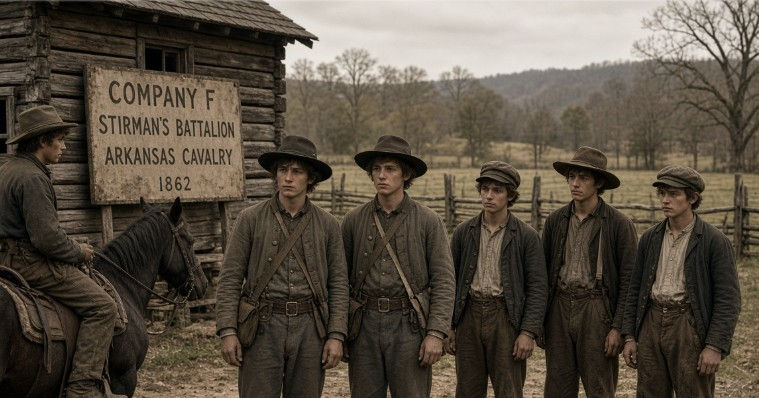
In 1862 Marcellus Greene, then seventeen, and Purnell Finley, fifteen, enlisted with friends in Company F of Stirman’s Battalion, First Arkansas Cavalry, under Captain Russell. Marcellus was made corporal at once and rose quickly to sergeant.
After the war he would write now and then to the Russellville Courier Democrat, which is why later generations can still hear a voice from that farm. While the sons were gone, the homestead held Joshua, Jane, daughter Mary Jane (about ten when the fighting started), and the youngest boy, Joshua Orr, born March 16, 1855, and only six at the war’s beginning.

Peace did not put the household back together. In 1868 Mary Jane married John Franklin Darr, a farmer and businessman with a war record. Around the same time, Jane and twelve year old Joshua Orr left the place and moved in with Mary Jane. Family memory calls it a divorce and offers no cause beyond the usual wreckage of wartime.
Thereafter many of the children wrote the name Hearn, dropping the final e. Joshua stayed on the land alone until 1872, when he married Margaret Hoffman Harris, widow of Adolfus Harris. They had a daughter, Ella, who lived and died in Russellville.

Joshua signed his will with a mark on January 12, 1889. He left one dollar each to Moses A., Marcellus Greene, Pernell Finley, and Mary Jane Darr, one hundred dollars to Ella when she turned eighteen, and the remainder equally to the children of Joshua Orr Hearne as they came of age.
James M. Harkey was named executor. Witnesses were C. E. Campbell and W. D. Williamson.
The instrument was filed March 14, 1889. Joshua had already died on February 24, 1889, near Russellville. He was buried at Pisgah, on the corner of the ground he had claimed in 1844. Jane died March 23, 1891, at seventy-nine and was buried there as well.
What remains of him is the patent date, the cemetery on the hill, the will that named the children in birth order and then turned the land toward the youngest son’s line, and the neighborhood that still answers to a Carolina mountain name.
The farm was never all tillable. The family was never all present. The man who marked his last paper with an X had crossed a continent’s worth of unfinished country to plant both.


