Our Arklahoma Heritage: Historic Shawnee Chief moved to Mayes County after forced relocation in 1869
- Dennis McCaslin

- Sep 8, 2025
- 3 min read


In Shawnee history, few figures stand as prominently as Graham "Shawnee Chief" Rogers, a man whose life bridged Native assimilation amid the turbulent 19th century. Born around 1818 in Rogerstown, Missouri, to a white captive turned Shawnee leader, Lewis "Chinwa" Rogers, and Parlie Betty "Chalakatha" Blackfish,
Graham’s journey reflects the complexities of a people displaced by American expansion.
Today his legacy endures through a preserved cabin and tribal recognition, and we revisit the life of this remarkable leader who died 153 years ago on February 15, 1872, with a deep connection to Mayes Count, where he is buried in the Military Cemetery.

Graham’s early years were shaped by the Rogerstown Shawnee, a mixed-heritage band led by his father, who had been adopted by Chief Blackfish during the Revolutionary War. In 1828, at age 10, Graham joined about 100 band members in a forced relocation to Kansas Territory under the Treaty of 1825, settling near present-day Kansas City.
Educated at the Shawnee Methodist Mission in Turner, he mastered construction and farming skills under Rev. Thomas Johnson, skills he later used to build a two-story double-log cabin near Antioch Road ( at what is now 6741 Mackey Street, Overland Park.
By the 1840s, Graham rose as a progressive leader, marrying Anna (Pah-Qua-Tha) Carpenter in 1850 at the mission. Anna, daughter of Chief Kah-che-qua, bore him at least five children, including Rachel (1858–1935) and Simpson (1864–1894).

Their farm, expanded to 1,000 acres by 1858, thrived with crops like corn and tobacco, a testament to Graham’s ability to blend Shawnee traditions with settler practices.
Elected to the Shawnee Council in the 1850s, Graham championed electing chiefs over hereditary succession, a stance noted in an 1850s interview with historian Lyman Draper. In 1855, he and Joseph Parks became principal chiefs, navigating the 1854 Treaty of Shingeewaw Spring, which reduced Shawnee lands from 1.6 million to 200,000 acres.
Graham received 600 acres, later expanded, building a prosperous homestead valued at $14,000 by 1865.
After 1854, Ohio Shawnees dominated the elected council, with Graham, of Missouri descent, rising to principal chief in 1865. His leadership bridged factions, leading the council to sometimes act as the "United Tribe of Shawnees" in the 1860s.

Allied with the Ohio group, he accepted land allotments, unlike the Black Bob and Absentee Shawnees who resisted. Indian agents favored his council, urging unity, but opposition persisted, as evidenced by their 1865 letter to Commissioner Louis Bogy decrying historical wrongs.
During the Civil War (1861–1865), Graham’s neutrality and proximity to the Underground Railroad near Charles Bluejacket’s Quaker mission invited raids. He later claimed $2,660 in damages.
Post-1868, with Kansas statehood looming, he sold his land to Henry Coppock and relocated with the Loyal Shawnee to Indian Territory, specifically settling in Mayes County, near Pensacola.
This move was driven by the Shawnee’s forced expulsion from Kansas following the 1867 treaty, which aligned the Loyal Shawnee with the Cherokee Nation after their Union support during the Civil War.
His final years were spent in this region, cementing his connection to Mayes County.
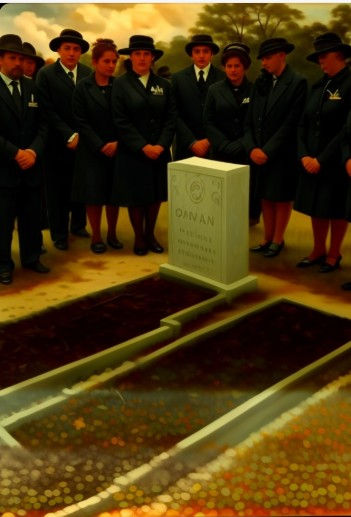
Graham’s death on February 15, 1872, at age 53–54, was mourned by Shawnee Lodge No. 54, A.F. & A.M., as recorded in an in memoriam notice. The lodge resolution, adopted April 30, 1872, praised his "Omnipotent will" and "united enjoyment" with departed friends, resolving to wear mourning badges for 30 days.
He was buried in the Military Cemetery in Pensacola, Mayes County, a resting place that reflects his status as a respected leader among the Loyal Shawnee who had integrated into the Cherokee Nation.
His burial there underscores his relocation and the community he joined in his final years, a direct result of the tribe’s displacement and alliance with the Cherokee.
His cabin, sold to Coppock (who expanded it into Oak Park Farm) and later to George Milburn in 1880, survives as a museum piece in Overland Park, reflecting Shawnee resilience.
Anthropologist Lewis Henry Morgan noted Graham’s hospitality during a 1859 visit. Today, the Shawnee Tribe, federally recognized in 2000, honors his legacy through cultural programs, with his Mayes County burial site adding a poignant chapter to his story.

Graham’s family ties underscore his blended heritage. His brother Lewis Rogers Jr. (1786–1844) and sister Mary Betsy "Polly" Rogers Beauchemie (1787–1848), who married\ a Delaware leader, strengthened alliances.
His children carried his legacy forward in Oklahoma, with Rachel living until 1935.
Graham "Shawnee Chief" Rogers remains a symbol of adaptation and resistance, his life a bridge between worlds in a time of upheaval. His burial in Mayes County marks the culmination of a journey shaped by displacement, leadership, and loyalty to his people, inviting us to remember a leader who shaped Shawnee survival against all odds.


