Our Arklahoma Heritage : From Oklahma school boy to President of Wake Forest University- James R. Scales
- Dennis McCaslin

- 5 hours ago
- 4 min read


James Ralph Scales was born on May 27, 1919, in Jay (Delaware County) to John Grover Scales Sr. and Katie Mae Whitley Scale His father, born April 19, 1889, along Spavinaw Creek in Indian Territory, was an enrolled member of the Cherokee Nation and devoted his life to the Baptist ministry until he died in 1971 at the age of 82.
His mother, born in 1897, lived until 1984. The couple married on April 25, 1914, and raised two sons in a household shaped by pastoral duties, Cherokee identity, and the normalcy of rural northeastern Oklahoma.
James Ralph and his younger brother John Grover Jr., born in 1923, grew up amid the lingering influences of the old Cherokee Nation. Through his father’s enrollment, Scales held citizenship in the Cherokee Nation and remained engaged with tribal matters for the rest of his life, even after his career carried him far from Oklahoma.

Family accounts and later commemorations at Wake Forest University recalled that his ancestors had walked the Trail of Tears, a history that informed his quiet but consistent support for Native causes and his pride in that heritage.
Scales graduated from Miami High School in 1934 and enrolled at Oklahoma Baptist University at the age of seventeen. He completed a bachelor’s degree there in 1939 and earned a master’s degree from the University of Oklahoma in 1941.
After military service, he returned to complete a doctorate at the University of Oklahoma in 1949, focusing on state politics, and pursued additional graduate work at the University of Chicago and the University of London.
Brief early jobs as a reporter for the Miami News Record and the Shawnee News-Star gave him practical experience before he began teaching at Oklahoma Baptist University as an instructor in 1940.

His rising academic career was interrupted by the Second World War. Scales entered the United States Navy in 1942 and served as an ensign until 1945. He completed training that included time at the Navy Reserve Midshipman School, as documented in a group photograph from November 1942.
Family archives preserve his naval hat, officer shoulder boards, portrait photographs from the wartime years, service records spanning 1941 to 1947, and wartime letters written between 1944 and 1945.
One certificate from 1943 records his participation in the traditional Solemn Mysteries of the Ancient Order of the Deep, the navy ceremony marking a sailor’s first crossing of the equator. He earned medals of honor and distinction for his service.
After the war, he received an honorable discharge, and later records show continued affiliation with naval reserve matters into the postwar decades. The experience of wartime service as a junior officer shaped the discipline and perspective he later brought to university administration.
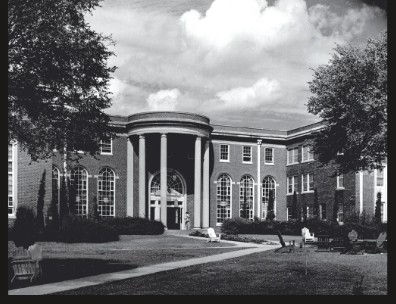
Upon returning to civilian life, he resumed his place at Oklahoma Baptist University, advancing to associate professor in 1947, serving as dean of men, and becoming professor of history and government. Administrative responsibility followed quickly.
He was named vice president in 1950 and executive vice president in 1953. On June 1, 1961, he assumed the presidency of his alma mater as its ninth president. In that office he worked to strengthen academic programs while remaining firmly within the Baptist educational tradition that had shaped him. He and his wife were active members of First Baptist Church in Shawnee, where Scales served as a deacon and she taught Sunday School.

He married d Elizabeth Ann RandeIn 1944 Scales married Elizabeth Ann Randel, known as Betty Ann, a 1939 Oklahoma Baptist University graduate born in Osage County to Clyde and Clara Wolcott Randel.
She shared his commitment to church and campus life and provided steady leadership in college, social, and Baptist organizations while raising their family. The couple had two daughters. Laura Elizabeth, born in 1949, died of cancer in 1969 at the age of twenty while a sophomore at Oklahoma State University.
In her memory the university cafeteria at Oklahoma Baptist University was named the Laura Scales Dining Hall. Ann Catherine, born in 1952, became a respected lawyer and legal scholar whose early work helped introduce and develop the concept of feminist jurisprudence. She died in 2012. Betty Ann Scales died on August 11, 1992.
Scales left the presidency of Oklahoma Baptist University in 1965 to become dean of the College of Arts and Sciences and professor of political science at Oklahoma State University. While there, he helped establish the literary quarterly Cimarron Review. He also remained active in Democratic Party affairs, serving as an alternate delegate to the 1956 Democratic National Convention.

In 1967 he accepted the call to become the eleventh president of Wake Forest University in Winston-Salem, North Carolina, a post he held until 1983. During his tenure undergraduate enrollment increased, the curriculum broadened, and the university’s formal relationship with the Baptist State Convention of North Carolina was carefully reduced.
He guided the construction of a fine arts center later named the James R. Scales Fine Arts Center and arranged for the acquisition of overseas study facilities, including Worrell House in London and Casa Artom in Venice. After resigning the presidency he was appointed Worrell Professor of Anglo-American Studies, a newly created chair.
In 1983 he was inducted into the Oklahoma Hall of Fame. He later co-authored the book Oklahoma Politics: A History with Danney Goble.

In his later years, Scales took up painting and mounted at least one public exhibition of his work. He continued to maintain ties to Oklahoma and to his Cherokee heritage.
James Ralph Scales died on March 12, 1996, in Winston-Salem, North Carolina, at the age of seventy-six. He was buried at Resthaven Memorial Park in Rock Creek Township, Pottawatomie County, Oklahoma.
The inscription on his marker simply records the institutions he served: OBU, OSU, and WFU. From a pastor’s home in the Delaware County hills to the leadership of two significant universities, his career embodied both the educational ambitions of mid-twentieth-century Oklahoma and a lifelong fidelity to the Baptist and Cherokee traditions that formed him.


