Our Arklahoma Heritage: From North Carolina to Franklin County, a pastor saw his share of frontier tragedies


n

In the winter of 1844, on a farm in Franklin County, Tennessee, Martha Isabel Pine Tree Cagle gave birth to a son she and her husband Henry Edward named Charles Arter. The boy grew up among the ridges and coves where his father’s people had settled after leaving the Piedmont of North Carolina.
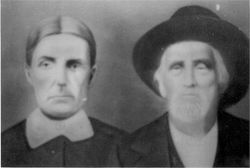
Henry’s own father, David Charles Cagle, had been born in Moore County in 1780 and had married his first cousin Susannah before moving west into Warren County, Tennessee.
The family carried the name through generations of small farmers, and by the time Charles was six years old the 1850 census found them still in Franklin County, Henry listed as a farmer, Martha keeping house, and the children ranging from thirteen-year-old Nancy down to the toddler Henry Carson.
Martha herself was known in family memory as “The Old Indian.” She had been born in 1815 in Georgia or the Cherokee Nation lands nearby, and descendants long believed she carried Cherokee blood through the name Pine Tree. She would outlive nearly everyone of her generation, dying in 1910 at ninety-four while living with her son Charles in Franklin County,
Arkansas.
Sometime around 1854, the family left Tennessee for the hills of Newton County, Arkansas, joining other Cagles and Standridges already settled along the White River drainages. By 1860, the household was enumerated in Richland Township.
In August 1864, he was wounded, his leg amputated, and he was sent to a hospital in Barnesville, Georgia. Still weak from the amputation, he returned toward home near Clarksville and was killed by bushwhackers, along with a young boy believed to be one of his sons.
The Civil War soon divided the region. Henry Edward Cagle enlisted in the Confederate 2nd Arkansas Mounted Rifles at Bentonville in July 1861. Records show him rising to second lieutenant.

In August 1864, he was wounded, his leg amputated, and he was sent to a hospital in Barnesville, Georgia. Still weak from the amputation, he returned toward home near Clarksville and was killed by bushwhackers, along with a young boy believed to be one of his sons.
Martha remarried Samuel H. Reynolds in Pope County in November 1865.

Charles, still a minor, chose the opposite side. On July 19, 1863, at the age of eighteen, he enlisted as a private in Company D of the 2nd Arkansas Cavalry, United States Army, at Springfield, Missouri, or near Jasper, Arkansas. His description on the roll listed blue eyes, auburn hair, fair complexion, and height of five feet nine inches.
Because he was under twenty-one, a guardian named William Conley signed the consent.
He was mustered in that November and served until his discharge on August 20, 1865. The pension file, later assigned him number 759420, would preserve the names and birth dates of his children for later generations.

Within months of the war’s end, he married Lydia Margaret Standridge on March 16, 1865, in Newton County. She was the daughter of Lemuel Owen Standridge and Sarah Margaret Blevins, and the couple settled into farming and family life in the same Richland neighborhood where Charles had grown up.
Eight children were born to them over the next fifteen years: Lemuel Riley in 1866, James Henry in 1867, Mary Ann in 1868, Martha Isabel in 1871, Burton Columbus in 1872, William Henry in 1874 who died the same day, Margaret Emeline in 1876, and finally Melvira in September 1880.
On September 3, 1871, Charles received original credentials as a Baptist minister in Newton County. He continued to farm while preaching, and later records placed his name on the Minister’s and Elder License Book in Haskell, Oklahoma, covering both Indian Territory and statehood years.
Family memory and census fragments place him driving wagons on a larger migration. In 1879, a group of related families from Newton County, Cagles, Standridges, Meeks, Lanes and others, headed their wagons toward Idaho Territory. Charles, already ordained and experienced on the road, served as one of the drivers. Some of the party stopped in Wyoming while others reached Albion in Cassia County, Idaho, where the 1880 census found Charles, then thirty-two, farming with Lydia and five of the children still at home.

They turned back toward Arkansas after that census. Somewhere on the return, members of the party drank contaminated water and typhoid fever struck. Lydia had given birth to Melvira only two weeks earlier, on September 14, 1880, in Lyon County, Kansas. On September 30 she died in Americus. Charles cut off her long dark hair and sold it to a man who made horse or buggy whips, the proceeds paying for her burial in the Americus cemetery.
The same outbreak claimed his son Burton Columbus, his sister Nancy Pine Tree Cagle Standridge, and his nephew General Alexander Standridge. Of the eight children born to Charles and Lydia, only five survived the journey and the fever. He hired a wet nurse for the infant Melvira and the smaller children, then continued home.

On March 27, 1881, still in Newton County, he married Mary Elizabeth Tilley, who had been the widow of the nephew lost to typhoid. She had been born in Searcy County in 1855.
Together they had eleven more children between 1882 and 1902: William David called Dave, Geneva who died in infancy, John Franklin, Molinda Ella called Linda, Willis Harrison, Sarah Lavina called Vinie, Nancy Jane who lived only a day, Amanda Louise called Manda Lou or Luizey, Susan V known as Maud and Susie, Nettie Gertrude, and Richard Huston. The family settled in the Ozark and Watalula area of Franklin County.
Watalula sits in the northern half of Franklin County, a few miles north of Ozark and just west of the ridges that climb toward the Boston Mountains. Franklin County itself was carved from Crawford in 1837 and named for Benjamin Franklin.
The Arkansas River cuts the county in two, leaving the southern side mostly open farmland and the northern side a broken country of timbered hills, hollows, and creek bottoms. Settlers from Tennessee, Kentucky, and the older Arkansas counties began moving in after the Cherokee cession of 1828. Ozark became the county seat in 1838.

By the time Charles Arter Cagle brought his second family into the neighborhood in the early 1880s, the northern townships were still sparse, with farms scattered along the better soils near creeks and with small crossroads places that existed mainly because someone had opened a store or a post office.
A post office named Watalula opened in 1881, the same year Cagle remarried. An 1895 atlas listed the place as having a post office but no railroad. The nearest rail line ran farther south along the river valley, so people in Watalula hauled their own produce or drove wagons into Ozark when they needed goods that the local store did not carry.
The land around the community drains into White Oak Creek and its forks, with smaller branches cutting narrow valleys between the ridges. Elevation runs from roughly six hundred to nine hundred feet. In the late nineteenth and early twentieth centuries the economy was ordinary hill-country farming: corn, some cotton on the better bottom ground, livestock, a few orchards, and timber.

Coal mines operated farther east in the county, and Swiss and German settlers near Altus and Denning were already planting grapes, but Watalula itself remained a farming and preaching district rather than a mining or wine town.
Charles Cagle lived out his last decades in Watalula Township. He farmed, continued as a Baptist minister, and in 1916 signed papers as an elder of the Free Will Baptist Church of Christ in nearby Ozark.
The 1920 census caught him briefly in Haskell County, Oklahoma, with his second wife Mary Elizabeth, but he returned to Franklin County before his death.
He died on December 20, 1924, in Watalula at the age of eighty. Burial was not in a small family plot at Watalula itself but a few miles northwest at Oak Ridge Cemetery, next to the Jethro community center.
His mother, Martha Isabel Pine Tree Cagle, who had lived with him in her final years, rests in the same ground. The cemetery sits on a ridge above the hollows, the kind of high, well-drained spot families chose for permanent graves when the low ground was reserved for crops and pastures.
The post office at Watalula stayed open until 1955. After that the name remained as the township and as a scattered rural community along Watalula Road and the connecting lanes that run toward Jethro, White Oak, and Cravens. Today the township covers about eighteen square miles and holds roughly six hundred people.

It is still unincorporated, still largely farm and woodland, and still close enough to Ozark that most daily business happens in town.
Across two marriages Charles fathered nineteen children whose names and dates, drawn from the family Bible and his Civil War pension file, match exactly.
The compelling history that remains is that of a man who crossed from Tennessee to Arkansas as a child, chose the Union in a divided border state, buried a wife and children on the Kansas prairie after selling her hair for the grave, then raised a second large family while preaching and farming among the hills he had known since boyhood, finishing his days in the quiet crossroads country of Watalula.


