Our Arklahoma Heritage: Father Patrick Francis Horan tended his flock through some turbulent years from 1906-1936


The granite at Calvary Cemetery on Lexington Avenue in Fort Smith names him Msgr. Patrick F. Horan, 1866 to 1936.
Patrick Francis Horan was born in Ireland on March 29 1866 in Offlay County, Ireland. .The church archives do not reveal the name of his parents, but they do give the name of the school that made him a priest, and the city that buried him tells the rest.
He studied at the Pontifical North American College in Rome, opened in 1859 so the Church in the United States could form its clergy beside the tombs of the apostles.
In 1892, in that city, Cardinal Lucido Maria Parocchi ordained him. Parocchi was Vicar of Rome under Pope Leo XIII.

On June 11, 1892, the same cardinal ordained John Baptist Morris at the Basilica of St. John Lateran. Morris would become the third Bishop of Little Rock. Both men came out of the same Roman house.
Horan was sent to America and placed in charge of the Church of Our Lady of Good Counsel in Little Rock. He remained there about twelve years, through the last stretch of Bishop Edward Fitzgerald’s episcopate. In Little Rock he held the degree of Doctor of Divinity, the mark then given to a Roman-trained priest trusted with a city parish.
Good Counsel was a younger south-side congregation in a small diocese still Irish and German. Catholics were few in Arkansas. Many neighbors knew the Church only as rumor: a foreign allegiance, a closed convent, a priest who answered to Rome.
That suspicion was older than Horan. In 1848 Bishop Andrew Byrne used borrowed money to buy a surplus tract of Camp Belknap in Fort Smith, land the federal government had given the public schools. The purchase, later called the Catholic mile, was meant for a college, a convent, and a parish.

Citizens sued.
The land sat in court into the 1850s. Byrne still brought Sisters of Mercy from Ireland.
They took Zachary Taylor’s old house in Fort Smith as St. Anne’s, opened schools, and in the Civil War nursed both armies. Statewide, the Know-Nothing Party of the 1850s said Catholics could not be real Americans because they answered to a pope.
The party won Little Rock’s city elections in 1856 after violence against the capital’s small Catholic population. Fort Smith’s Irish parish was already standing when that wave passed. The argument did not die with the party.

Around 1906. Horan was moved west as pastor of Immaculate Conception in Fort Smith, following Father Lawrence Smyth, who had held the parish from 1861 until 1908.
He inherited the Gothic church dedicated in 1899 after a cyclone wrecked the building of 1867.

The parish had begun with Irish labor. Michael Manning, come from New Orleans to work on the fort, is remembered as the first Irish Catholic in the town. The first Mass was said in his house. He gave land for a log church of St. Patrick at Third and North D Streets. After the Civil War the people used officers’ quarters, then the church of 1867, then the present church at 22 North 13th Street.
Horan arrived as the next storm was gathering. Around 1910, lecturers and papers revived convent tales of imprisoned nuns and priestly vice. In 1912 the Reverend Joseph A. Scarboro of Magnolia launched The Liberator, an anti-Catholic weekly that claimed 15,000 readers.

In 1915, the General Assembly passed the nation’s first convent-inspection law so sheriffs could search houses of sisters for “enslaved” nuns. The first inspection, at Mena, found none. The law still told every Benedictine and Sister of Mercy in Arkansas that rumor had the force of a warrant.
During the World War, many Arkansas German speakers were Catholic, and loyalty tests folded into the same charge: Rome, beer, and a foreign tongue.
After the war, the Ku Klux Klan of the 1920s made anti-Catholicism a main plank in Arkansas. Organizers opened early chapters in Little Rock, Fort Smith, Pine Bluff, and Texarkana. On May 16, 1923, the Southwest American reported 26 Klansmen standing on a building at Ninth and Garrison.

On August 10, 1924, a notice called every Klansman and Klanswoman in Sebastian County to 1108 Garrison Avenue. The Klan forced a recall of Mayor Fagan Bourland, accusing him of slackness toward bootleggers and prostitutes. Bourland was Catholic.
In that election, he carried only one box, at the Catholic recreation hall. On June 27, 1923, the Southwest American wrote that David L. Ford’s victory over Bourland was generally conceded a Ku Klux Klan victory.
In 1924 and 1925, the Benedictine sisters of St. Scholastica moved their motherhouse from Shoal Creek into a large Gothic house on Albert Pike, in the same city, in the same years.
That is the Fort Smith in which Horan was pastor. By 1922 a state history called him a forceful speaker, often asked to address public meetings, popular with all classes and greatly loved by his own.

The praise was not empty. A priest who could stand in a civic hall, speak without apology, and still be trusted outside his parish was holding a place for people the Klan called inauthentic Americans, alleged plotters against the schools and the government.
Lecturers such as Basil Newton and the Baptist editor Ben Bogard made the Church the chief enemy in Klan tracts. Horan’s standing in the city was the answer his parish could offer without a pamphlet of its own.
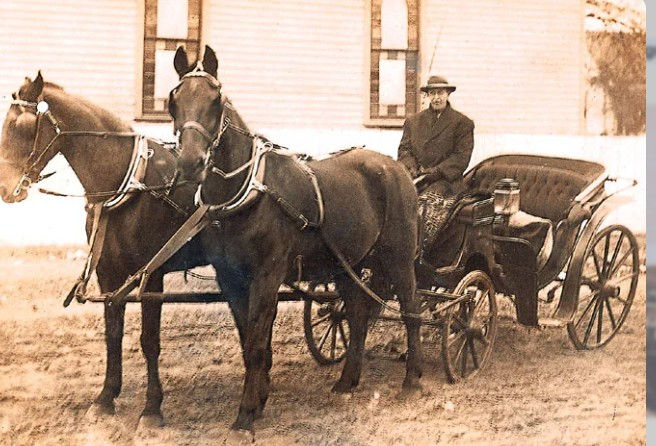
Rome later named him monsignor, a papal household honor, not a diocesan rank. Pius X, Benedict XV, or Pius XI may have signed the brief. Bishop Morris would have sent the petition. Horan was never a curial official.
He was a Doctor of Divinity who had been a seminarian in Leo XIII’s Rome and a pastor in Morris’s Arkansas, known on both sides of Garrison Avenue as a public man as well as a priest.

According to archival information, Father Horan (who was still the head of Immaculate Conception) traveled to New Orleans and arrived on March 17, 1936 in order to catch a ship to Ireland for a sabbatical and to visit his family. He died there a few days later, after which his body was brought home to Fort Smith and the Calvary Cemetery.
The formal Klan in Arkansas collapsed by the late 1920s. Open agitation faded further after the 1928 ticket of Catholic Al Smith and Arkansas Methodist Joe T. Robinson, and after John F. Kennedy’s election in 1960.
What remained of Horan’s work did not depend on that thaw. Immaculate Conception still hears Mass in the church he kept. Children still cross the yard of the school beside it. The Sisters of Mercy’s nursing and teaching, and the Benedictines’ house on Albert Pike, outlasted the inspection law and the klavern on Garrison.
He lies at Calvary among the people whose baptisms, marriages, and burials filled his years in Fort Smith.
The stone is spare. It does not name a deathbed or a city. It gives the title Rome conferred, the year 1866, and the year 1936.
That is enough. The rest of the record is not cut in granite. It is a parish that still stands in a town that once sued over a Catholic mile, elected a Klan mayor over a Catholic one, and still fills the pews on North 13th Street.


