Our Arklahoma Heritage: Controversial OKC mayor, Oklahoma governor sowed his educational roots in Fort Smith


In the vibrant and often volatile history of Oklahoma politics, few figures stand out as vividly as John Calloway “Jack” Walton (1881–1949), the state’s fifth governor, whose brief tenure was marked by bold reforms and a dramatic fall.
Born in Indianapolis, Indiana, on March 6, 1881, Walton’s path to power was shaped by his early years in Fort Smith, Arkansas, where he gained the education and grit that fueled his ambitious career
. From his roots in Fort Smith to his impeachment after just 10 months as governor, Walton’s life was a whirlwind of populist fervor, battles against the Ku Klux Klan, and unrelenting controversy.

Walton’s family moved from Indianapolis to Lincoln, Nebraska, before settling in Fort Smith, Arkansas, during his youth. In this bustling river town, young Walton attended Fort Smith Commercial College, acquiring skills that would later underpin his engineering career.
He worked as a railroad timekeeper in Fort Smith, a job reflecting the town’s role as a transportation hub.

At 16, he enlisted in the U.S. Army in 1897, serving six years, including a stint in Mexico, though he saw no combat during the Spanish-American War. Discharged in 1903, Walton studied engineering in Mexico City and worked briefly as a salesman in Kansas City before settling in Oklahoma Territory.
There, he co-founded the McIntosh and Walton Engineering Company around 1913, setting the stage for his political rise. Fort Smith, though a brief chapter, was pivotal in shaping Walton’s early work ethic and ambition.
By 1917, Walton had become a charismatic force in Oklahoma City’s Democratic Party. Elected Commissioner of Public Works, he won the mayoral race in 1919, campaigning with jazz bands and fiery speeches that captivated voters but rankled journalists, who viewed him as an upstart.

As mayor, Walton launched a “Purity Squad” to combat crime and clashed with the city commission over police control. In 1921, he accused half the Oklahoma City police of ties to the Ku Klux Klan, ordering an investigation and shrugging off threats from the group.
His support for striking meat packers and opposition to martial law after the 1921 lynching of Jake Brooks won him allies among the Socialist Party and the Farmer-Labor Reconstruction League, paving the way for his gubernatorial campaign.The Governor’s Meteoric Rise and Fall
In 1922, Walton rode a wave of populist support to secure the Democratic nomination for governor, backed by the Farmer-Labor Reconstruction League’s progressive platform. Defeating Klan-supported rivals in the primary and Republican John Fields in the general election, he was inaugurated on January 9, 1923, with
As governor, Walton pushed bold reforms: free textbooks for schools, increased welfare spending, stronger agricultural protections, and a farm stabilization program. However, his opposition to the death penalty, liberal use of pardons, and appointment of allies to state jobs alienated the legislature and eroded his support.
Walton’s fiercest fight was against the Ku Klux Klan, which boasted 75,000 to 105,000 members in Oklahoma by 1923. In June, he declared martial law in Okmulgee County to curb Klan violence, deploying 400 National Guard troops. In August, after a brutal assault in Tulsa, he imposed martial law there, leading to arrests of Klansmen.

By September, Walton explicitly targeted the Klan, banning their demonstrations. His suspension of habeas corpus and declaration of statewide martial law to block a grand jury investigation outraged legislators, who saw it as an overreach. On October 16, 1923, the House filed 22 impeachment charges, including illegal campaign funds and excessive pardons.
On November 19, the Senate convicted him on 11 counts, removing him from office. Lieutenant Governor Martin E. Trapp succeeded him, ending Walton’s 10-month tenure—the shortest in Oklahoma history.Life After the Fall, Death, and Burial
Unbowed, Walton ran for U.S. Senate in 1924, winning the Democratic nomination but losing to Republican William B. Pine in a landslide. His impeachment spurred Oklahoma to adopt a primary runoff system to prevent minority nominations, a lasting electoral reform.
Walton lost a 1931 bid for Oklahoma City mayor but won a seat on the Oklahoma Corporation Commission in 1932, serving until 1939
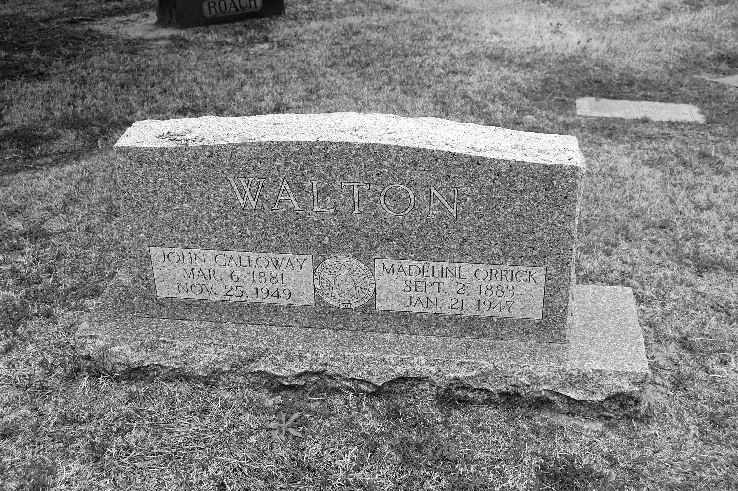
. Unsuccessful gubernatorial runs followed in 1934 and 1938. Retiring to private law practice in Oklahoma City, Walton suffered a stroke and died on November 25, 1949, at age 68 in Oklahoma City’s St. Anthony Hospital. He was laid to rest in Rose Hill Burial Park in Oklahoma City, where his grave remains a quiet testament to his turbulent legacy.
Survived by his wife, Madeleine Orrick, and their daughter, Mrs. C.E. Martin, Walton’s papers were donated to the University of Oklahoma in 1950, preserving his story for future generations.


