Our Arklahoma Heritage: An incredible artistic journey began in 1924 Haskell County with the birth of Mary Baker-Fiegel
- Dennis McCaslin

- Dec 8, 2025
- 3 min read


Mary Baker-Fiegel was born in 1924 in Stigler, the seat of Haskell County a small farming community in the Choctaw Nation's former lands where cotton fields and timber stands defined daily life.
Her parents, Guy Baker and Buena Victoria Trent Baker, had married on April 13, 1910, in Stigler after Guy, born in 1889 in Arkansas to John Thomas Baker and June Etta McBride, moved to the area as a young man. Buena, born around 1892 in Oklahoma, came from a pioneer family rooted in the territory's settlement.
The couple raised their children amid the economic hardships of the 1920s and Dust Bowl years, with Guy working as a farmer and laborer to support the household.
Mary grew up alongside siblings including Joe Elmer, born in 1917, and Edsel R., born in 1922, both in Stigler, in a home that emphasized creativity during Oklahoma's transition from Indian Territory to statehood.

The family's ties to the landi instilled in Mary an appreciation for the human form and natural scenes that later defined her art.
After attending Oklahoma City University, where she met her future husband, Alpha "Al" Fiegel, Mary pursued formal art training at three universities, the Art Students League in New York City, and private instructors, honing skills in oil, watercolor, pastel painting, and sculpture in terra cotta, marble, and bronze.
She and Al, a World War II and Korean War veteran who became an advertising executive famous for penning the B.C. Clark Christmas jingle in 1956, married and settled in Oklahoma City, raising three children: daughter Stephanie Gray of Tucson, Arizona, and sons Barry and Tim Fiegel of Oklahoma City.
Mary's career took flight in the 1960s and 1970s with exhibitions across the U.S., from Santa Fe and Houston to San Francisco and a 1978 show at New York's International Gallery on 82nd Street and Madison Avenue, where a Park East critic praised her "remarkable sense of color" and ability to capture subjects' personalities.

In 1971, she unveiled a bronze bust of President Dwight D. Eisenhower in Oklahoma City's Stars and Stripes Park; she also sculpted and exhibited a head of President John F. Kennedy.
By 1979, seeking broader horizons, the couple moved to Geneva, Switzerland, with time in Monaco, where Mary continued her work. There, she exhibited at the Athenee Museum in 1984 with Monaco scenes endorsed by Prince Rainier, painted a portrait of young Prince Albert in 1986, unveiled at the Hotel de Paris. She saw and saw her Palace of Monaco painting grace the principality's phone book cover that year.
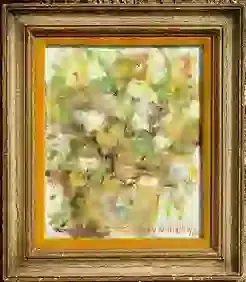
In 1988, a Tokyo gallery show of European florals led to a CNN commission for 10 impressionistic Japan paintings, aired worldwide in 1989. Geneva honored her with a 1990 Victoria Hall exhibition, a purchase by Societe de Banque Suisse, and a Journal de Geneve "artist of the year" feature. all rarities for non-Swiss creators.
Over her life, she sold more than 2,000 portraits, emphasizing speed to preserve authenticity: "The client cannot sit for a long period without getting tired, and it shows in the result."
Mary Baker-Fiegel died in 2010 at age 86, her later years split between Europe and family visits to Oklahoma and Arizona; specific details of her passing remain private. Al followed in 2013, cremated per his wishes.
Mary's burial arrangements were handled discreetly, likely with ashes returned to family in Oklahoma.

Her parents' graves, located in the Stigler Cemetery, are an everlasting connection to the artists and the land she never fully left behind.
Her legacy endures in public collections from Eisenhower's bust to Monaco's salons and private homes worldwide, a testament to an Oklahoma farm girl's ascent to international acclaim. Through her portraits and sculptures, she captured not just faces but the quiet determination of everyday lives, much like the Arklahoma prairie's own steadfast spirit.
Her works, now stewarded by children and grandchildren including Jessica Mraz in Switzerland, remind Haskell County that heritage travels far but always circles home.


