Our Arklahoma Heritage: An Illinois Civil War veteran who fathered 21 children is buried in a Chismville cemetery
- Dennis McCaslin

- 54 minutes ago
- 6 min read


Chismville sits in western Arkansas, a short ride from the old Indian Territory line that later became Oklahoma. The ground looks like much of that border country: farm ridges, small churches, and cemeteries that hold more story than the stones can carry.

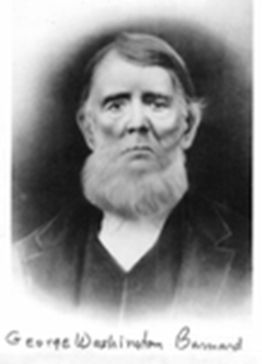
At Spring Hill Cemetery a flat Confederate tablet names one of them. GEORGE WASHINGTON BARNARD. SGT. GUNTER'S CAV. BN. CONFEDERATE STATES ARMY. SEP 5, 1818. SEP 11, 1900.
That marker is the surest record of his rank and unit. The longer record is the household behind it. Three wives. Twenty-one children. A farmer who walked from the Alabama Territory through Tennessee into the Arkansas hills, rode as an aging sergeant in the Trans-Mississippi war, and came home to keep raising children into his sixties.
He was born on September 5, 1818, while Alabama was still becoming a state. His parents were John Barnard Jr. of Goochland County, Virginia, and Mary Polly Grissom, also given as Griffith. They married in Knox County, Tennessee, on November 8, 1813. John drowned in the Holston River about 1830 in Grainger County, Tennessee, when George was still a boy. Family notes say Polly was of partial Cherokee ancestry. That claim has not been proven on tribal rolls, but it is the sort of family memory that follows people west along the same trails that later fed the Nations and the Oklahoma settlements.

The Barnards kept moving. Census years find George in Claiborne County, Tennessee, in 1840 and 1850. His children give other footholds. Marcus Monroe was born in Henry County in 1837. James Isaac, called Dike, was born in Carroll County on March 8, 1843. About 1847 or 1848 the family crossed into western Arkansas and settled in the Six Mile country that later became Logan County. George was a farmer. There is no store, mill, or courthouse office in the compiled record.
About 1834, at roughly sixteen, he married Elizabeth Mills, born about 1815. Family tradition says they had eleven children. Ten are named before her death: Zadoc Zadrack Zedie Barnard, 1835 to 1864; Jackson Lafayette Barnard, 1836 to 1900; Marcus Monroe Barnard, 1837 to 1903; Ruhama Artmacia Barnard McVay, 1839 to 1917; Benjamin Franklin Frank Barnard, 1841 to 1917; James Isaac Dike Barnard, 1843 to 1893; George Taylor Barnard, 1844 to 1860; Lydia Anne Liddie Barnard Laxton, born 1846; Ruth A. Ruthie Barnard, 1847 to 1850; and an infant son, 1848 to 1848.
Ruthie and the unnamed boy died small. George Taylor died about 1860, still in his teens. Elizabeth died in 1859, on the eve of the war, leaving George a widower with sons old enough to carry a rifle.
His second wife was Sarah Mary Aydelott, 1843 to 1870, daughter of Thomas Jefferson Aydelott and Mary H. Erwin, born in Maury County, Tennessee. She was more than twenty years younger than George. They had four children: Mary P. Barnard Breazeale Hogan, 1861 to 1901; Thomas Levi Barnard, 1862 to 1930; Robert Alexander Barnard, 1866 to 1941; and Richmond Pate Barnard, 1869 to 1954. Sarah died in late 1870 or 1871, in her late twenties, and was buried at Spring Hill. George was a widower again, with small children in the house and older sons already marked by the war.

That war, for families on this side of the Arkansas River, was not Virginia. It was the Trans-Mississippi: thin cavalry, long raids, and fighting that spilled toward Indian Territory as often as toward Little Rock. Gunter's Cavalry Battalion, also called the 3rd Battalion Arkansas Cavalry, was raised in late 1863 and early 1864 under Lieutenant Colonel Thomas M. Gunter. It served in Brigadier General William L. Cabell's brigade of Major General James F. Fagan's cavalry. The battalion fought in the Camden Expedition at Elkin's Ferry, Poison Spring, and Marks' Mills, and later on Price's Missouri Raid.
The Spring Hill stone and a Confederate pension application dated 1897, listed in compiled trees as Arkansas History Commission application 2661, identify George as a sergeant in that battalion. Muster rolls for Gunter's command barely survive. Rank and unit rest on the tablet, the pension note, and the battalion's known path.

Marks' Mills, April 25, 1864, was an ambush of a Union supply train moving from Camden toward Pine Bluff. After about five hours the Federal column collapsed. Confederate losses were reported near 293. Union losses ran to more than a thousand, most captured. Steele abandoned Camden two nights later. The fight is also remembered for the killing of Black civilians and teamsters after the shooting stopped. Family tradition says George was wounded there and served with three sons.
That second half does not hold as a simple roster. His son Marcus Monroe enlisted Confederate on June 25, 1862, as a private in Company E, 35th Arkansas Infantry, at Charleston. He deserted on September 10, 1863, walked home, and on October 1, 1863, enlisted in the Union Army at Clarksville in Company C, 2nd Arkansas Volunteer Infantry. He served until August 8, 1865. By Marks' Mills he was on the other side. The sons of fighting age in 1864 were Zadoc, who died that year; Jackson Lafayette; Marcus; Frank; and James Isaac. Zadoc's death fits the war, but no unit card for him has turned up in open indexes. Jackson, Frank, and James Isaac are still unmatched.

The fair reading is that the father was remembered as a wounded Confederate sergeant at Marks' Mills, that some of his sons served, and that they did not all ride in the same command on the same morning. That split, Confederate father and Union son, is a border-country story as much as an Arkansas one. Families along the Territory line made the same hard choices.
In 1871, the year Logan County was created, George married Calfurna Haynes Lee, a widow. She was born May 22, 1840, at Mount Hope, Lawrence County, Alabama, daughter of Alexander Haynes Lee, 1810 to 1871, and Mary Ann Stephenson Lee, 1819 to 1864. She was about twenty-two years younger than George, not thirty-two. When they married he was about fifty-three and she about thirty-one. When he died he was eighty-two and she was sixty.
Her first husband was Addison T. Smith, born about 1833. They married August 5, 1860. He died in the Civil War, a Confederate, about 1865. One compiled tree places the death at Lavaca, Sebastian County, Arkansas. They had two children: Louella Mary Smith Owens Barnard, 1861 to 1902, and Everett Alexander Smith, 1863 to 1892. Calfurna came to George as a war widow with those two. The household then knotted tighter when Louella married George's son James Isaac Dike Barnard. Calfurna was both his third wife and the mother of his daughter-in-law.

With George she had seven children: Hugh W. Barnard, 1872 to 1878; Sarah Calfernia Barnard Watson, 1874 to 1921; an infant daughter, 1877 to 1877; an infant son, 1877 to 1877; Virginia F. Barnard, 1878 to 1880; Lucinda Elizabeth Barnard Coleman, 1879 to 1962; and William Marshall Barnard, 1880 to 1887. Four of the seven died in childhood. Lucinda lived until 1962. Sarah Calfernia's name is her mother's name, passed down.
Counted together the three marriages give twenty-one children on the family list: ten named with Elizabeth, four with Sarah, seven with Calfurna. Not all grew up. Zadoc died in 1864. George Taylor died at about sixteen. Hugh, the 1877 twins, Virginia, and William Marshall died young. The others seeded Logan and neighboring counties with Barnards, McVays, Laxtons, Breazeales, Hogans, Watsons, and Colemans, and from those hills later generations moved on, as so many Arkansas families did, into the new state across the line.
The 1880 census still finds George and Calfurna in Six Mile, Logan County. In 1900 George, eighty-one, married, head of household, was in Washburn Township. In 1897 he applied for the state Confederate pension Arkansas had begun paying impoverished veterans in 1891. He died September 11, 1900, at Chismville. Calfurna died March 29, 1905, age sixty-four, and was laid near him
. Family story says she died of a broken heart. The record is quieter. She was a Civil War widow who married an older farmer, buried babies and a husband, and followed him four and a half years later. Her stone remembers both men: wife of Addison T. Smith, wife of George Washington Barnard.

Oklahoma history is not only the land inside today's borders. It is also the people who lived against those borders, fought the same Trans-Mississippi war, and raised families in the same upland world of farms, pensions, and crowded graves. George Washington Barnard never became a general and never became a planter. He was a boy from a drowned father's Tennessee household who married at sixteen, moved west, buried a wife on the eve of the war, rode as a sergeant in Cabell's cavalry, came home, married twice more, and kept fathering children into his sixties
. The war is one chapter. The longe

r book is the census line that keeps reading farmer, married, head of household.


