Our Arklahoma Heritage: A Name That Endures-The Legacy of Pvt. William Wylie Wright and Wright City



Deep in McCurtain County, Oklahoma, where pine forests stretch toward the horizon and a thirty-minute drive will take you to Texas, lies Wright City.
. Originally called Bismark, the town shed its old name during World War I to pay homage to Private William Wylie Wright, a local hero whose life was cut short in service to his country.
Born on September 27, 1890, in Jensen in Sebastian County, William Wylie Wright grew up in the rugged logging towns of southeastern Oklahoma after his family relocated there around 1915.

The son of James Marion Wright and Louiza Jane Blackwood Wright, William worked in the Dierks Lumber Mill, a cornerstone of the region’s economy. When duty called on June 5, 1917, he enlisted in the U.S. Army, training at Fort Travis, Texas, before joining the 20th Engineers, 6th Battalion, Company F--a unit vital to constructing wartime infrastructure.
Tragedy struck on February 5, 1918, when the troopship Tuscania, carrying Wright and over 2,000 American soldiers toward France, was torpedoed by a German U-boat off Islay, Scotland. Of the 210 lives lost, Wright was among them, his promising future swallowed by the icy North Atlantic.

The kind-hearted residents of Islay recovered the bodies and provided dignified burials, a gesture that underscored the global impact of his sacrifice. In 1920, his remains were brought home and laid to rest with honor at Arlington National Cemetery, Section 18, Site 927.
The loss resonated deeply in his hometown. Amid anti-German sentiment -- evoking the name of the German chancellor--became a point of contention.
On September 13, 1918, the U.S. Post Office renamed the town Wright to honor its first war casualty. Confusion with other towns called Wright and Wrightsville prompted another change on May 18, 1920, to Wright City, cementing William’s legacy in its identity.

This shift reflected not just a break from the past but a commitment to remembering a fallen son.
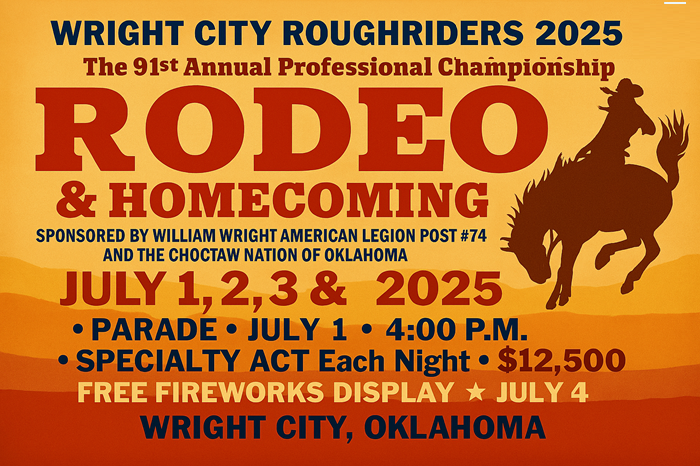
The community’s reverence endures through the American Legion William Wright Post 74, founded in the 1930s, which remains a vital part of local life. Each year, from July 1 to 4, Wright City hosts one of Oklahoma’s oldest continuous rodeos.
Begun in 1933 by local cowboys as a rodeo, barbecue, and dance, it has been sponsored by the William Wright Post since 1935, blending celebration with remembrance. This event, rooted in the town’s logging heritage, symbolizes the resilience of a place shaped by both industry and sacrifice.
Wright City stands as a testament to William Wylie Wright’s enduring name--a legacy carved into its streets, sustained by its people, and honored in the annual rhythms of the rodeo.


