Our Arklahoma Heritage: A jurist with ties to a young Abe Lincoln became an Indian Commissioner during the Civil War


The man who spent the last years of the Civil War trying to hold the Cherokee Nation together from a garrisoned post at Fort Gibson was not a stranger to hard country or to the law.
Justin Harlan was born on December 6, 1800, in Warren County, Ohio, the son of George Harlan and Esther Eulass. His people belonged to the old Harlan line that traces to George and Michael Harlan, Quakers who left the north of England and Ireland and settled in Chester County, Pennsylvania, in 1687.
From that Pennsylvania hearth the family drifted south and west. George Harlan, born in North Carolina in 1767, married Esther in Warren County in 1796 and raised a large family of sons and daughters on the Ohio frontier.
Justin grew up among them, took what the public schools and an academic course could give him, taught school for a time, and then read law in Cincinnati in the office of John McLean, the jurist who would later sit on the Supreme Court of the United States. He finished his legal training with Judge Callett and, in 1825, carried his books and his ambitions into Illinois.

He first stopped at Palestine, then settled at Darwin on the Wabash, where he practiced law and served as justice of the peace.
In 1832 he married Lucinda Hogue, a young woman born in Knox County, Indiana, in 1812. That same year he rode with the Illinois militia in the Black Hawk War and served out his term as orderly sergeant of his company. The couple began their family at Darwin. Howard, Cyrus, and Edwin were born there.
In 1840 they moved to Marshall, the rising seat of Clark County, and the rest of the children, William, Emily, Mary, Justin, and Wilson, were born in that town. A daughter, Cornelia, died in infancy. Lucinda and Justin would raise eight children to adulthood in a household that mixed circuit riding, county politics, and the ordinary work of a prairie family.
Illinois made him a judge almost as soon as it made him a resident. The legislature elected him circuit judge in 1835. He sat on the Fourth Judicial Circuit from 1835 to 1841 and again from 1849 to 1861, more than seventeen years in all, longer than any other man who held that bench in Clark County in the nineteenth century. Lawyers remembered him for a prodigious memory, a store of old court stories, and what one local history called sterling manhood and unshakable honesty.

Abraham Lincoln appeared before him more than once. In 1847 Harlan went to Springfield as a Whig delegate to the Illinois Constitutional Convention. When the guns opened in 1861, he was sixty years old, a sitting circuit judge, a husband and father, and a man whose public life had been spent among farmers, litigants, and the rough democracy of the Wabash counties.
President Lincoln appointed him United States Indian agent for the Cherokee after the death of Charles W. Chatterton. Official records list the appointment as September 11, 1862. Harlan himself dated it September 19 and said he entered on his duties on October 6.
He found the agency buildings near Tahlequah standing but in poor repair and the official papers gone. The land, he wrote, was desolate, homes burned, the people who remained living in fear. Confederate occupation had driven the Union agency first to the Sac and Fox Agency in Kansas.

Harlan worked from there, then from Fort Gibson, where three Indian regiments and occasional white or Black units held a small circle of ground. In July 1863 smallpox forced him back to Kansas. He left A. G. Proctor as acting agent and returned in November to reestablish the post.
On August 1, 1865, from the Cherokee Agency, he answered a congressional committee with the report that still stands as one of the clearest wartime accounts of the Nation.
“I was appointed United States Indian agent for the Cherokee on September 19, 1862, and since that time I have been almost constantly with them,” he wrote. “Living most of the time at Fort Gibson, guarded by three regiments of Indians, and in the Indian country where the loyal refugee Indians came for protection, I had many opportunities of seeing and hearing what their wants were.”

He counted about twenty-two thousand Cherokee at the opening of the rebellion, of whom 8,500 went south and 13,500 remained. Early in 1861, he said, rebel emissaries came into the country to turn the tribes against the United States. Under John Ross the Cherokee first assumed what Harlan called a kind of Kentucky neutrality.
Later that year the neutrality was thrown off and two Cherokee regiments entered the Confederate army. Many refused to go. Some who had gone came back and enlisted with the Union. Some fled the Nation altogether.
He told the story of Opothleyohola and the loyal Creeks, the first victory, the second defeat, the night of snow a foot deep, the frozen dead on the road into Kansas. In the Cherokee Nation, he wrote, rebel Indians, protected by the rebel army, murdered, robbed, and captured the loyal, stole horses and cattle and household goods, and burned homes.

Some fled into the mountains and stayed through the winter. In the spring of 1863 smallpox broke out, and many would not be vaccinated. Most of the men who remained, and many who returned from the South, enlisted as Union home guards. After April 1863, when the Indian regiments were posted at Fort Gibson, the pattern of the war in the Nation became a bitter farce of protection.
When bushwhackers crossed the Arkansas, the Indian soldiers were called in to defend the fort while their families were left to insult, outrage, plunder, and sometimes murder. The raiders left loaded with goods. The pursuers came back loaded with plunder of their own, reported a great success, and rested. “Thus the Cherokee have been robbed by their enemies and by their protectors until they are literally destitute.”

He wrote of the people as he found them. Nearly all cultivated some land. Few farmed on a large scale. The men, he thought, were often indolent and plowed too shallow. The women were slow but steady and industrious. The soil was rich. Before the war almost every family had stock. Some counted animals by the thousands.
Half-blood families often became wealthy. Full-blood families too often left the fields to women and children. Cherokee law allowed husband and wife to hold property separately, and among the full-bloods the women frequently owned most of the livestock.
Looking forward, Harlan refused the easy language of conquest. The United States had made treaties and had acknowledged that the tribes had rights.
“This regulating Indians out of one territory into another, enforcing it by arms, is always oppressive, and can only be justified as a necessary war measure in time of actual hostility. All our transactions with the Indian tribes should be by treaty and only by treaty.”

He remembered the old promise of protection given when the Cherokee surrendered their lands in Georgia, North Carolina, Tennessee, and Alabama. When they needed that protection in Indian Territory, with their men in the Union army, the government had suffered them to be robbed and murdered for more than two years.
“This they know, for they felt it and they feel it still. This and other acts makes them distrustful of everything proposed by white men.”
Colonel Elijah Sells, superintendent for the Southern District, wrote in October 1865 that it did no violence to truth to say that since the rebellion began 300,000 head of cattle had been driven from the Indian country without consent or pay. Two classes of operators worked the trade. One stole from the range. The other waited on the Kansas line with bills of sale and drove the herds to market.
Government agents later estimated that some 200,000 cattle and 40,000 horses were taken from the Creek and Cherokee alone. Congress, in January 1865, finally put a heavy penalty on the traffic. It came too late for the herds.
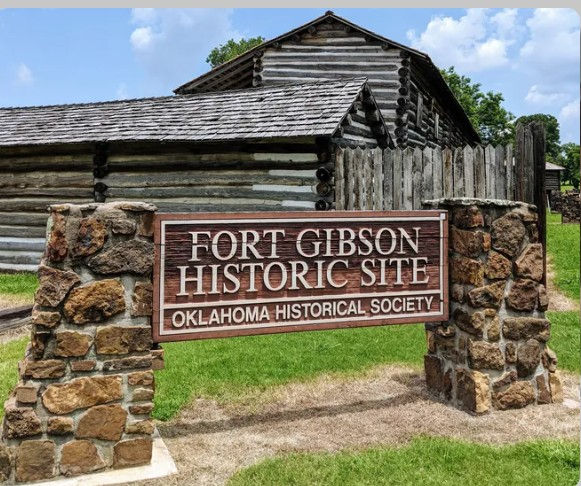
Harlan stayed through the first months of peace. In May 1866 he approved, as agent, the sale of the old Arkansas agency reservation. John J. Humphreys received the appointment as his successor on September 25, 1866.
Harlan went home to Marshall. The war had taken four years of a life already long in public service. He was elected county judge of Clark County in 1873 and served until 1877, a quieter bench than the circuit he had ridden for nearly two decades, but the same man, the same reputation for a legal mind and common sense.
On March 12, 1879, while visiting a daughter in Kuttawa, Lyon County, Kentucky, Justin Harlan died at the age of seventy-eight. They brought him back to Illinois and buried him in Marshall Cemetery at Marshall, Clark County. Lucinda lived until 1892.
The children scattered into the ordinary American story of farms, professions, and later wars.
The report he wrote at Fort Gibson in the summer of 1865 did not scatter. It remains the testimony of a Midwestern judge who had seen Lincoln in his courtroom, Black Hawk’s war as a young sergeant, and then, late in life, a Nation stripped of stock, houses, and trust, and who still insisted that the only honest way forward was the way of treaty.
That insistence, written in the wreckage of Indian Territory, is part of the inheritance Oklahoma still carries.


