Our Arklahoma Heritage: A hand-hewn cabin on a secluded Latimar County road has a historic story to tell
- Dennis McCaslin

- Oct 11, 2025
- 4 min read


Nestled within a wooded valley along a tranquil country lane in southeastern Oklahoma stands the Edwards Store cabin, a log building that has served as a silent witness to nearly two centuries of American history.
Erected around 1850 by the Englishman Thomas Edwards, this unassuming structure has been a home, a mercantile, a post office, and a crucial stagecoach stop, observing the evolution of Indian Territory into the state of Oklahoma.
Today, a new chapter unfolds as the descendants of the Edwards-Hardaway family, in partnership with the nonprofit organization The Edwards Store, Inc., endeavor to restore this historical gem to its antebellum glory, ensuring its profound legacy is preserved for posterity.

The genesis of the Edwards Store is a story of cultural intersection on the American frontier. Its founder, Thomas Edwards, was an Englishman whose global sojourns ultimately led him to Indian Territory in the 1840s. There, he married Nancy Hardaway, a Choctaw woman whose family had endured the forced migration from their ancestral lands in Mississippi along the Trail of Tears.
linked to the Choctaw's painful relocation.
. Around 1850, utilizing pine logs harvested from the surrounding forests, Edwards constructed a single-room cabin upon a foundation of stacked sandstone, likely quarried from the nearby Brazil Creek. A formidable stone chimney, fashioned from the same local sandstone, anchored the cabin's eastern wall.
The site rapidly evolved into a vital node of activity. Auxiliary structures were erected, and the Edwards Store became animportant stop for both the local's and transient pioneers.

Its significance was amplified in 1858 when it was officially designated a noon meal depot for the Butterfield Overland stage line. This transp[ortation route represented America's first great experiment in transcontinental public transportation, ferrying passengers and the U.S. Mail from St. Louis to San Francisco.
Remarkably, the Edwards Store remains the sole original structure still standing along Oklahoma's 192-mile segment of this historic trail.

.Over the decades, the cabin's architecture was modified to accommodate the evolving needs of its inhabitants, creating a physical record of its history. In 1870, a second log room was added to the west, joined to the original by a covered breezeway, or "dog trot," a design familiar to the region.
The living space was further expanded in 1889 with the addition of a three-room wood frame extension. A significant act of preservation occurred in the early 20th century when a tin roof was installed over the original wood shingles.
This metal roofh, while modern, inadvertently protected the older structure beneath it, where remnants of the decayed shake shingles still lie today, a testament to the cabin's layered past.
More than a mere commercial enterprise, the Edwards Store was a cornerstone of the Red Oak community in Indian Territory. It was designated as the settlement's first post office in 1868, a role it fulfilled until the town's relocation in the 1890s. Though the Civil War brought the Butterfield stage line to a halt, the store persisted as a waypoint for travelers and a critical supply source for local agrarians for another fifty years.
Its history is also intertwined with the era of frontier justice; it served as an embarkation point for fugitives and outlaws apprehended by deputy U.S. Marshals, who transported them to the federal court in Fort Smith, for trial before Judge Isaac C. Parker.
Thomas Edwards himself was known to have testified in Parker's court on occasion.
.Following the deaths of Thomas in 1883 and Nancy in 1888, their nephew, Jesse Hardaway, assumed proprietorship. A respected figure in Red Oak who also served as justice of the peace, Jesse managed the store into the 20th century.
The final family residents were his youngest son, Edgar, and daughter-in-law, Lula Hardaway, who lived in the cabin until 1981. The store itself ceased commercial operations just prior to Oklahoma's statehood in 1907, yet the cabin endured as a family home.
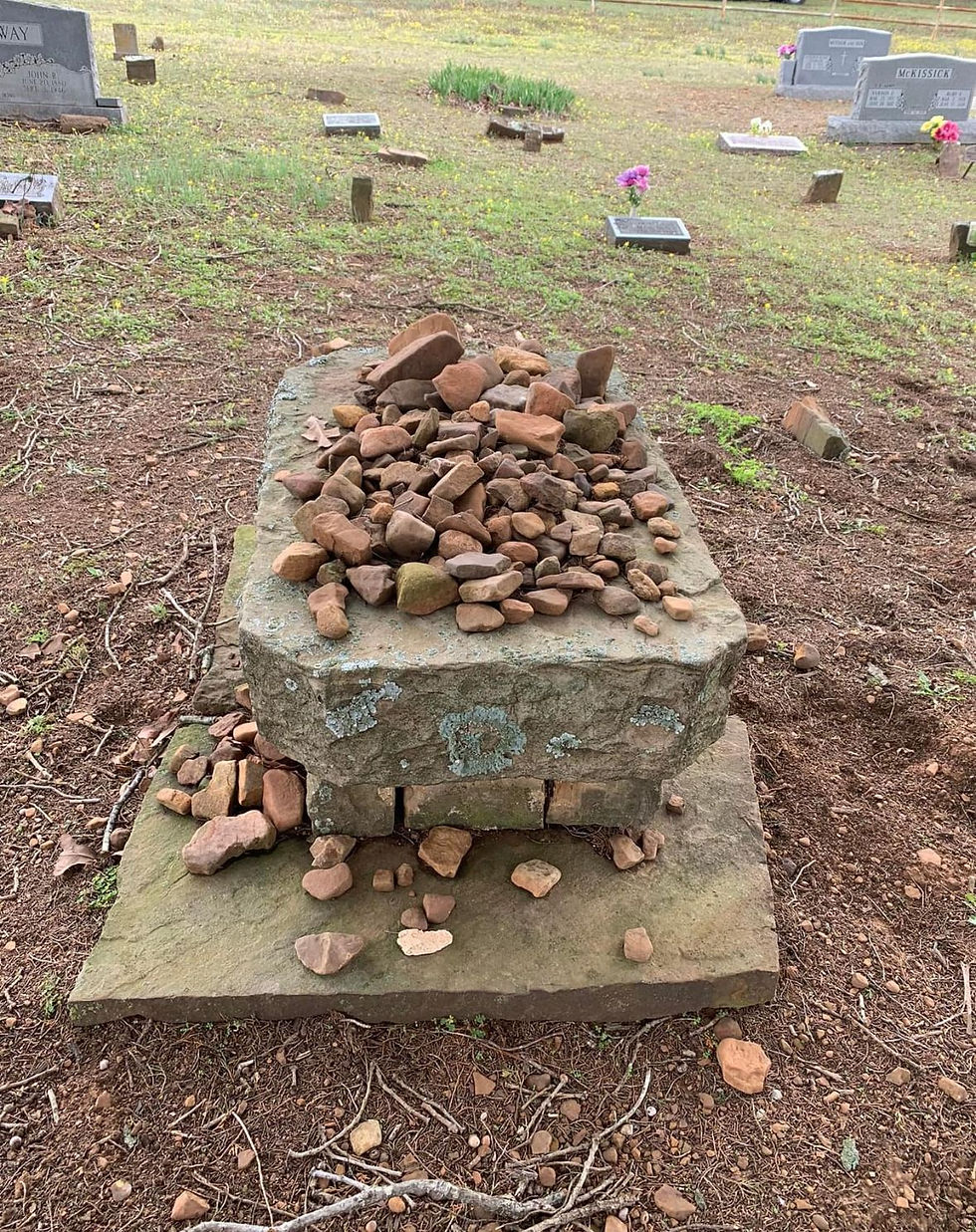
The Edwards-Hardaway family's profound connection to this land is sanctified by the Hardaway-McCann family cemetery, located just a hundred yards west of the cabin. Here lie the remains of Thomas and Nancy Edwards, and the active cemetery continues to serve as the final resting place for their descendants, physically anchoring the family's lineage to the property.
Today, the site remains under the private ownership of E.C. Guyton, Chrissy K. Dickmeyer, and Brian J. Gray, all direct descendants of Jesse Hardaway. In a profound commitment to its future, they have granted a long-term Preservation Easement to The Edwards Store, Inc., legally ensuring its protection and development as an educational historical site.
The cabin's historical importance was formally acknowledged with its inclusion on the National Register of Historic Places in 1971. By 2018, however, its state of decay led Preservation Oklahoma to name it one of the state's five most endangered historical sites, a designation that galvanized preservation efforts.
.The nonprofit's mission is to meticulously restore the structure to its pre-Civil War appearance, preserving the integrity of the hand-hewn logs, sandstone foundation, and dog trot design.
You can learn more about the efforts to restore this piece of Oklahoma history by clicking the link HERE.


