Our Arklahoma Heritage: A drunken ride in 1886 installs a postal rider as the first inmate in the Tamaha jail

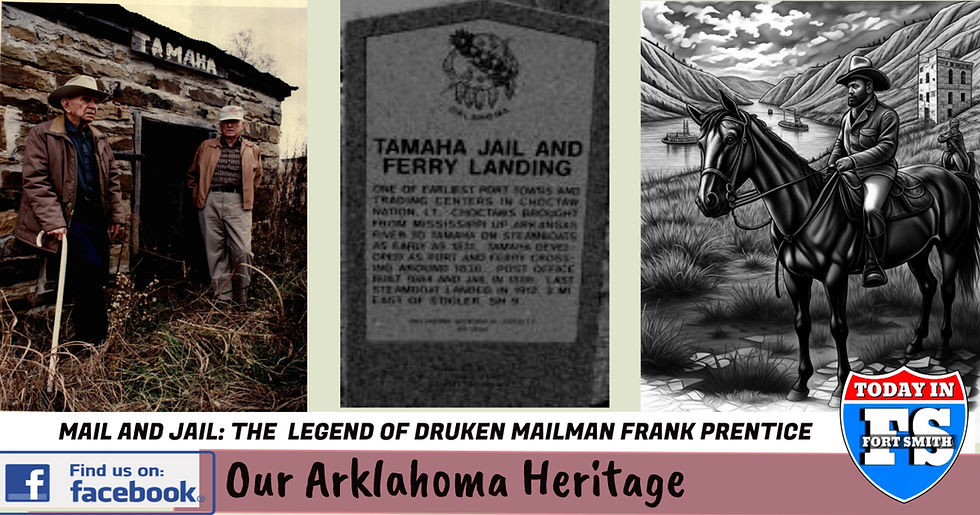


In the rust-red hills of Haskell County, where the Arkansas River makes a slow, deliberate bend, the ghost of a town whispers its stories to the wind.
Tamaha, once a bustling riverport in the heart of the Choctaw Nation, is now little more than a memory etched into the landscape. Yet, standing defiant against time is a single, crumbling stone cell: the Tamaha Jail.
And within its silent walls lives the unlikely legend of its first and most famous inmate, a horseback mail carrier named Frank Prentice.
Long before the Sooner State existed, Tamaha was a vital artery of commerce and travel in Indian Territory. Established in 1831 as Pleasant Bluff, it served as a landing for Choctaw people during their forced removal on the Trail of Tears. The name itself, "Tamaha," is a Choctaw word for "town," a testament to its indigenous roots.

By the late 19th century, it had blossomed. As a key ferry crossing and steamboat landing, Tamaha connected Fort Smith to Fort Gibson, moving cotton, furs, and vital correspondence. Its peak in the 1890s saw a thriving community with general stores, blacksmiths, and cotton gins.
But its fortunes were tied to the river. The arrival of the Kansas City Southern Railway, which bypassed the town, and the decline of steamboat traffic after 1912 signaled the beginning of the end. Devastating fires in 1919 and 1930 erased what little remained, leaving Tamaha to the mercy of nature.
Today, the only significant structure left from that era is the jail.

Built in 1886 from rough-hewn native sandstone, the Tamaha Jail is a stark, one-room symbol of frontier justice. Measuring a mere 10 by 12 feet, it was constructed to serve the Moshulatubbee District of the Choctaw Nation, making it one of the oldest--if not the oldest--surviving jails in Oklahoma.
According to enduring local lore, its first occupant wasn't a hardened outlaw, but Frank Prentice, a local man with a thirsty predicament.

Born in Sebastian County in 1879 to Confederate veteran Major Hampton "Hamp" Prentice and Eliza Jane Black, Frank was a product of the pioneer spirit that settled the region. He married Rose Nell “Nellie” Clem in 1901 and, like many, took up work essential to the rural community: carrying the mail on horseback.
The legend, still told with a smile in Haskell County, unfolds along the Whitefield-to-Tamaha mail route. As the story goes, Frank stopped for a drink--or perhaps several--along his journey. By the time he rode into Tamaha, his mailbag was conspicuously light.
Letters, packages, and parcels were strewn for miles behind him, discovered by residents in creeks and bushes for days afterward.

The incident was such a spectacular failure of federal duty that upon his arrival, the embarrassed and inebriated postman was promptly detained in the town’s new jail to "sober up."
No official charges were ever filed, and Frank soon returned to his family and work, but the story stuck. His brief, unceremonious stay cemented his place in local history as the jail’s inaugural guest.
The Prentice family was deeply woven into the fabric of Haskell County. Frank's father, Maj. Hamp Prentice (1840-1916), and mother, Eliza Jane (1853-1917), were among the early settlers who helped establish farms and communities.

Frank himself lived until 1950, raising six children with Nellie. He, his wife, and his parents are all buried together in the nearby Garland Cemetery, a testament to a family that saw Indian Territory become the state of Oklahoma.
In 1980, the historical significance of the area was formally recognized when the Tamaha Jail & Ferry Landing were added to the National Register of Historic Places
While the ferry landing is now quiet, reclaimed by nature and managed by the U.S. Army Corps of Engineers, the jail remains. Though its roof has collapsed and its walls are crumbling, it stands as a rare, tangible link to Choctaw Nation law, steamboat commerce, and the everyday lives of frontier Oklahomans.
Frank Prentice's life was, in many ways, ordinary. He was a husband, a father, and a working man. But his one legendary misstep has outlasted the town he served. It provides a human face to the ruins, reminding us that history is not just made of grand events, but also of small, imperfect moments--of mail, mischief, and a memory that refuses to fade along the banks of the Arkansas River.


