Our Arklahma Heroes: Bokoshe-born soldier received the nation's highest military honor for his stand on Luzon


William Ralph Shockley was born on December 4, 1918, in the small town of Bokoshe in LeFlore County, Oklahoma, a place whose name comes from the Choctaw word for little creek.
The town had grown around coal mining in the old Choctaw Nation lands, with railroads arriving early in the twentieth century to haul out the black rock that sustained local families. Shockley arrived into a household that, like many others in that hardscrabble corner of eastern Oklahoma, knew the rigors of mine work and the uncertainties of rural life.
By the time of the 1930 census, the family had moved west to Tempe, Arizona, where his father, known as Bill Shockley, worked as a farmer. The household included at least one other child, Harold.

The Depression years pushed many such families farther still, and by the late 1930s the Shockleys had settled in the agricultural country around Selma in California’s San Joaquin Valley.
Shockley’s formal schooling is not extensively recorded, but he grew up between the coal hills of LeFlore County and the irrigated fields of California, leaving formal education behind when opportunity or necessity called him into uniform.
In January 1940, at age twenty-one, Shockley enlisted from Selma into the National Guard’s 128th Infantry Regiment. The regiment was part of the 32nd Infantry Division, the Red Arrow Division, drawn largely from Wisconsin and Michigan but open to recruits who joined its ranks.
Federalization followed in October 1940 as the nation prepared for possible war. The 1940 census found him listed as a soldier living in the barracks at the Presidio in San Francisco.
After the Japanese attack on Pearl Harbor, the division trained in the United States, then crossed the Pacific. It reached Australia in May 1942 and became one of the first American units to enter sustained combat against Japanese forces in the Southwest Pacific.
Elements of the 128th Infantry fought in the brutal Papuan campaign around Buna in late 1942 and early 1943, then in subsequent New Guinea operations at Saidor, Aitape, and elsewhere.
Shockley earned a Purple Heart and the Combat Infantryman Badge amid the jungle fighting of New Guinea. The division later moved to Leyte in the Philippines in late 1944, then to Luzon in January 1945 as part of the drive to clear northern Luzon and open the Cagayan Valley.

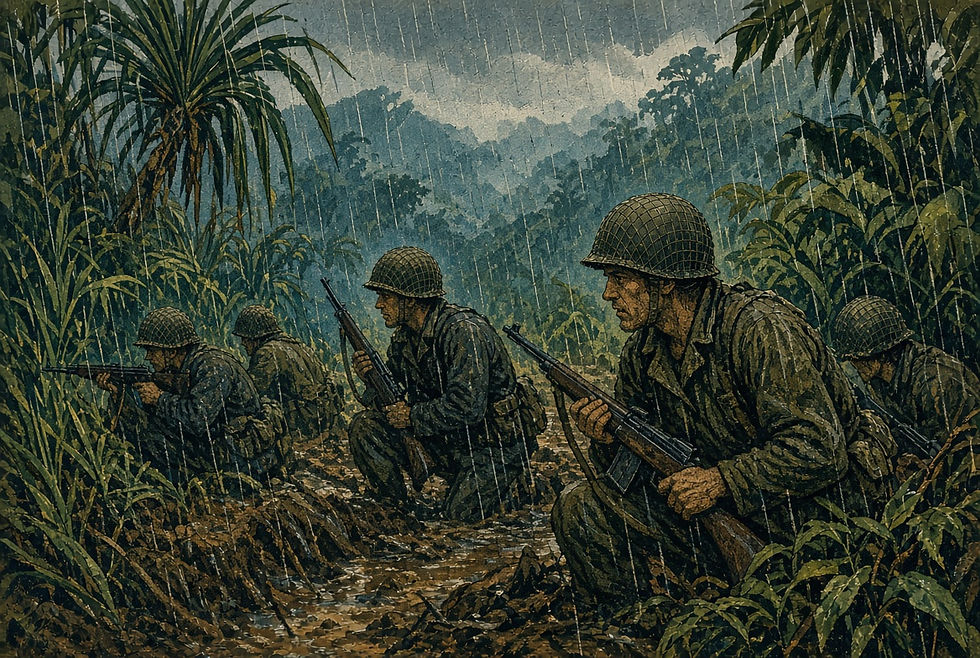
On Luzon, the 32nd Division was assigned the Villa Verde Trail, a narrow, steep path through the Caraballo Mountains that Japanese forces had fortified with caves, interlocking fire, and successive defensive lines.
\
From late January into May 1945 the Red Arrow Division advanced yard by yard against determined resistance.
Casualties were heavy from both combat and the diseases of the mountains.
On March 31, 1945, Company L of the 128th Infantry held positions on a hill when Japanese artillery concentrated on the American line and a counterattack followed. Shockley, by then a private first class, remained under the intense fire. He urged his squad to withdraw and told them he would remain to the end to give covering fire.

His weapon suffered two stoppages that he cleared under fire, allowing him to halt one enemy charge.
When hostile troops began to move against his left flank he shifted the gun and engaged them.
Realizing the only route of escape was being cut off, he ordered the remainder of the squad to safety and deliberately stayed at his post.
e continued firing until he was killed in the ensuing charge. Later, four Japanese soldiers were found dead in front of his position. The covering fire he provided allowed his squad to reorganize and press the attack.

The official citation records that, facing certain death, he sacrificed himself to save his fellow soldiers, and that the heroism and gallantry he displayed enabled the unit to continue.
Shockley was twenty-six years old.
He received the Medal of Honor posthumously on October 19, 1945, under War Department General Orders No. 89, together with the Bronze Star and a second Purple Heart. His name stands as the only Medal of Honor recipient from LeFlore County.

His remains were returned to the United States and interred on February 19, 1949, in Floral Memorial Cemetery in Selma, California, in Block D, Row 16, Space 3, near his mother, True Ollie Shockley.
The headstone records his rank, unit, and the Congressional Medal of Honor. In the long record of the Red Arrow Division, which logged more days of combat than any other American division in the war,
Shockley’s final stand on the Villa Verde Trail remains a precise measure of one soldier’s choice to hold the line so that others could live.


