Our Ark-Lahoma Heroes: Billy Bob Walkabout is the most decorated Native American from the Vietnam War


Billy Bob Walkabout was born March 31, 1949, in Cherokee County into the Blue Holly Clan, Anisa


Billy Bob Walkabout was born March 31, 1949, in Cherokee County into the Blue Holly Clan, Anisahoni, of the Cherokee Nation. His father was Warren Gerald Walkabout, born May 14, 1922, in Muskogee, the son of John Walkabout and Jeanette Caudrey, who had married in Tahlequah in 1910.
John Walkabout himself had been born in 1887 in the Tahlequah District of the Cherokee Nation. Warren married Bobby Jean Chaudoin on August 30, 1946, in Sebastian County.
Their children included James Henry Walkabout, Warren Gene Walkabout, born November 19, 1947, and Billy Bob. Family records place the Walkabout line in the Tahlequah district and in Hendricks Cemetery near Tahlequah, where Warren was later buried after his death in 1979.

The family later lived in Oklahoma City. Walkabout attended Jefferson Middle School and graduated in 1968 from U.S. Grant High School. That same year he enlisted in the United States Army. He went to Vietnam as a combat infantryman with Company F, a long-range reconnaissance unit of the 58th Infantry attached to the 101st Airborne Division.
On February 1, 1969, that company became L Company of the 75th Infantry (Ranger). He served about 23 months in country and left the Army as a second lieutenant.
The action that defined his record came on November 20, 1968, southwest of Hue. Then a specialist fourth class, later cited as a sergeant, Walkabout was on a long-range patrol that ambushed an enemy squad on a jungle trail and called for helicopter extraction. As the lead man moved toward the pickup zone he was badly wounded by automatic weapons fire.

Walkabout stood and laid down steady suppressive fire while teammates pulled the wounded soldier back, then gave first aid. As that man was being loaded, the enemy attacked again. Walkabout moved under fire to the point where the assault was heaviest and kept firing.
A command-detonated mine tore through the team, killing three men at once and wounding the rest. Stunned and wounded himself, he went from man to man, bandaged a severe chest wound, and revived another soldier with heart massage. He coordinated gunship and tactical air strikes, then worked alone under fire to get the disabled men aboard evacuation helicopters.
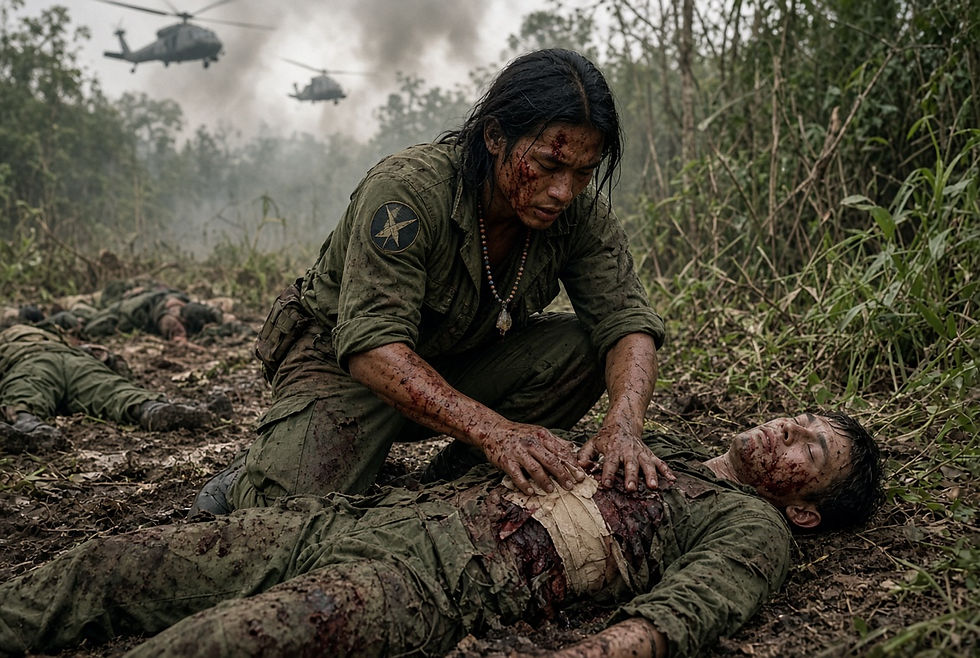
Only after the casualties were out and reinforcements arrived did he allow himself to be extracted.
Headquarters, U.S. Army, Vietnam, General Orders No. 3945 in 1969 awarded him the Distinguished Service Cross for that day. The award had been upgraded from a Silver Star. The official citation is the firm record of the fight. Obituaries and later biographies also credited him with five Silver Stars, ten Bronze Stars (five with the valor device), seven Air Medals, ten Army Commendation Medals (five with valor), and six Purple Hearts.
The shorter public lists, including Wikipedia, confirm the Distinguished Service Cross, a Bronze Star, an Army Commendation Medal, a Purple Heart, and the Ranger tab. Either accounting placed him among the most decorated Native American soldiers of the Vietnam War, a description used by the Department of Defense and by writers who covered his death.

The war stayed with him. In a 1986 Associated Press interview he said his 23 months in Vietnam left disabling injuries and memories that would not fade, and that “war is not hell, it’s worse.” He also said he had never lost a day of it, and that even when he was wounded, he had not lost.
He lived for years with post-traumatic stress, isolation, and suicidal thoughts. The place he found relief was at Native American powwows. Exposure to Agent Orange left him with kidney failure. He waited for a transplant and took dialysis three times a week.
He married more than once. Records list a marriage to Patricia Corey in Oklahoma City in 1982 and another to Debra Lynn Gibson in Muskogee in 1998. In April 2000 he married Juanita Medbury, a Mohegan, and they lived in Montville, Connecticut.
Accounts of his children name sons Justin Walkabout and Jason Knapp, both of whom served in the Army, and, in the Department of Veterans Affairs account of the later marriage, Amy Rene, Justin, and Trista.
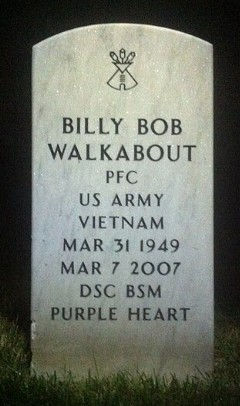
Walkabout died March 7, 2007, at 57, of pneumonia and renal failure in a hospital in Norwich, Connecticut. He was buried at Arlington National Cemetery, Section 66, Grave 59.
His headstone reads "Billy Bob Walkabout, PFC, U.S. Army, Vietnam", with the Distinguished Service Cross, Bronze Star, and Purple Heart noted, and a Native American symbol.
Cherokee artist Talmadge Davis painted him in Walkabout: A Warrior’s Spirit. The Cherokee Nation placed a bench beside the Cherokee Warrior Memorial at the Veterans Center in Tahlequah, inscribed for the Distinguished Service Cross awarded for November 20, 1968.
In 2008 an Oklahoma legislator proposed naming a mile of Interstate 40 the Billy Walkabout Memorial Mile. Gary Linderer, one of the men wounded that day southwest of Hue and the author of Eyes of the Eagle, wrote that he had watched Walkabout earn a Medal of Honor before his eyes.
The Distinguished Service Cross is what the Army awarded. The bench in Tahlequah and the grave at Arlington are where the Cherokee Nation and the United States chose to keep his name.


