Our Ark-La-Hoss: Two brothers from South Carolina applied for pensions after coming to Crawford County in 1834


In the early spring of 1834, two elderly men made their way, with difficulty, to the home of Justice of the Peace John Shannon in Crawford County, Arkansas Territory. They were brothers--Clement Mobley, who would turn eighty-eight that October, and Isaiah Mobley, then seventy-nine. Both were nearly blind with age and infirmity; neither could easily reach the distant courthouse.
On February 7 they swore out declarations under the federal pension act of 1832, seeking recognition for service they had rendered more than half a century earlier in the South Carolina militia.
Clement spoke first of his birth. He had been born on October 4, 1746, in Bedford County, Virginia, the son of Clement Moberly (or Mobley) Sr. and Mary Fox. The family had moved south into the Craven District of South Carolina ((later Fairfield County) while he was still a boy.
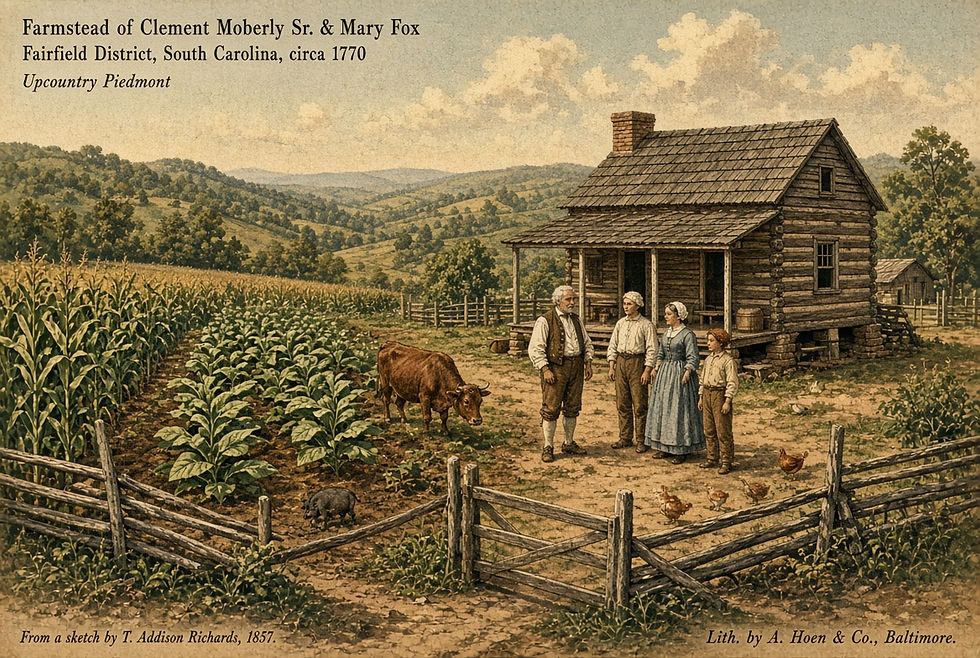
Isaiah, born December 14, 1754, in that same South Carolina district, had known no other childhood home. Their father, an earlier migrant from Maryland through Virginia, had already established the family among the upcountry settlers who would fight the Revolution largely as militia.
Both brothers had entered service in the summer of 1775. Clement was drafted for three-month tours under Captain Robert Hancock in Colonel John Winn’s regiment; on one early call he paid fifty pounds to hire a substitute. He later served under Captain John Bowie (attached to Colonel Robert Stark’s command), Captain Arramanus Liles and Lieutenant Ephraim Lisle under Colonel Richard Winn, and Lieutenant William Vaughn under Colonel David Hopkins

. Isaiah’s tours ran parallel: he volunteered and was later drafted under Lieutenant Ephraim Lisle, Captain Bowie, Captain John Pearson, and Captain William Vaughn, serving under the same colonels—John Winn, Richard Winn, Stark, and Hopkins. General Thomas Sumter held overall command during much of their time in the field.
Neither man claimed to have stood in a great set-piece battle against British regulars. Their war was the grinding, local war of the Carolina backcountry: short tours of two or three months, mustering at Orangeburg, Ninety Six, the Savannah River opposite Augusta, the forks of the Edisto, the Four Holes, and Marshall’s Mill.
They skirmished with Tories and, in Isaiah’s case, with Indians. Isaiah carried a permanent reminder of a musket ball that passed through one forearm between wrist and elbow.

Clement kept a few scraps of paper: an oath of fidelity sworn in 1778 on the Broad River, and later permits signed by Colonel Hopkins and General Isaac Huger. Most of Isaiah’s papers had burned in a house fire in 1806. Both men insisted their total service amounted to roughly a year or more; the government ultimately pensioned each for nine months at thirty dollars a year.
After the war, the brothers followed the familiar westward current. Clement left South Carolina for Madison County, Kentucky, soon after the peace, appearing on early tax lists there; he later settled in Warren County. Isaiah remained longer in Fairfield District, then joined the Kentucky migration in 1807, also settling in Warren County. I
n 1830 Isaiah moved once more, this time to the Arkansas Territory, establishing himself on Lee Creek in what became Crawford County. Clement followed in April 1831. They found themselves among the first wave of settlers in that narrow valley where families named Moore, Peavehouse, Harrell, Howell, and otherslived between the Boston Mountains and the Arkansas River bottoms.

By the time they stood before Justice Shannon, both men were living in the same neighborhood. Clement’s wife Sibella and Isaiah’s wife Frances (née Coleman) each gave supporting affidavits, testifying to the brothers’ long-known character and to the fact of their wartime service. Clement himself attested for Isaiah; Isaiah returned the favor.
Within weeks the federal rolls carried their names. Clement, however, lived only a few weeks longer. He died in March 1834, still in the Cove City / Lee Creek settlement. Isaiah survived another two and a half years, dying on October 23, 1836, at the age of eighty-one.

They were buried side by side in a small rural burying ground that later became known as Kimbler Cemetery, a few miles east of present-day Cedarville on what is now Arkansas Highway 220. Their markers, still legible, identify them simply as privates in Winn’s South Carolina troops of the Revolutionary War.
In 1835 both names appeared on the federal pension roll for Arkansas; local histories of the early twentieth century remembered them as two of the county’s few surviving soldiers of the Revolution.
No dramatic last words or precise cause of death beyond advanced age survive in the record, but. for a few years in the early 1830s, the Mobley brothers were living witnesses to the Revolution in a territory that had not yet become a state.


