Cold Case Files: The 137-year-old Madison County murder of Isom Ritchie is still an unanswered question
- Dennis McCaslin

- 2 days ago
- 4 min read


A Madison County farmer who lived in the south Madison County community of Dutton near the Johnson County line was shot and killed in what remains the unsolved backside of a mystery that has hung in the hills and hollowsof northern Arkansas for almost 137 years.
On a Tuesday evening in late November 1889, as darkness settled over the Ozarks, 71- or 72-year-old Isom Solomon Ritchie was attacked inside his home. A single ball entered his back, passed clean through his body, and lodged under the skin in front. Robbers took his money. He was still alive and sensible the next morning when neighbors found him.
He died later that day--November 26, 1889--in Dutton.
No one was ever charged. The killers vanished into the same rugged country that had drawn Ritchie and his family from Kentucky decades earlier.
Isom Solomon Ritchie was born about 1817 in Perry County, Kentucky, the son of Alexander Crockett Ritchie and Susan Elizabeth “Betsy” Grigsby. On December 31, 1834, he married Martha “Patsy” Patrick in Perry County. The couple raised a large family. Around 1850–1851 they joined other Ritchie kin migrating west and settled in Madison County, Arkansas.

Census records track him as a farmer through the decades: Mooney Township in 1860, Valley Township in 1870, and Hilburn Township by 1880, where he appears as a married father living in the household of his son James. By the time of his death, he lived in the Dutton area, roughly four miles east of the settlement referenced in local reports.
Dutton itself was still a young and modest settlement in 1889. Its post office had opened only eleven years earlier, on September 20, 1878, in Section 6 of Township 13, Range 25. The community sat in the timbered southern reaches of Madison County near the Johnson County line, in country where virgin hardwood forests were just beginning to draw commercial attention.
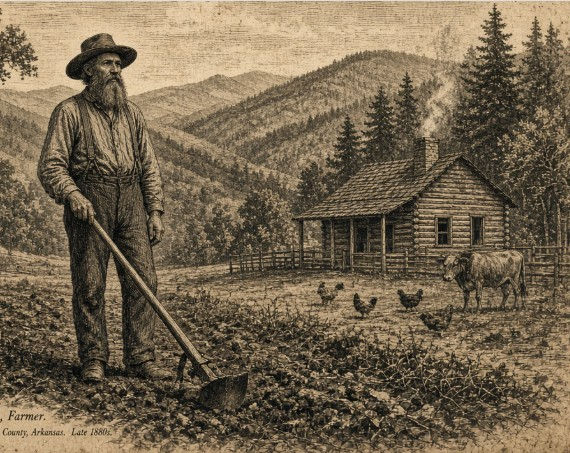
Railroads had only recently started pushing into the southern half of the county, turning places like nearby St. Paul into shipping points for lumber, railroad ties, and barrel staves. In 1895 Dutton still had a post office but no rail service of its own; that would come later, when the Frisco line reached the area, and the community became known for its large tie yards.
By the early 1900s thousands of railroad ties were stacked around the local general store, and a proper depot was built around 1910. In Ritchie’s day, however, Dutton remained a quiet farming and timber community where a man who kept cash at home could become a target.

Family tradition and descendant accounts describe him simply as a man who had worked the land for decades and kept money in the house--enough, at least, to attract deadly attention.
Two local newspapers recorded the sparse facts that still survive. The Fayetteville Democrat of Friday, November 22, 1889, carried a brief notice: “Isom Ritchie of Dutton in Madison County was attacked by robbers and killed. Word was received here today that Mr Isom Ritchie of Dutton, Madison County, was attacked by robbers and killed, no particulars.”
The St. Paul Republican, also dated November 22, 1889, offered more detail supplied by Bryant Williams Sr. of Boston Township: “ISOM RITCHIE, who lives four miles east of town, was fatally shot Tuesday evening about dark. The ball entered Mr Ritchie’s back and passed clear through his body, lodging under the skin in front. It is not known who did the shooting. Mr Bryant called to see the wounded man Wednesday morning, he was still alive and sensible.”
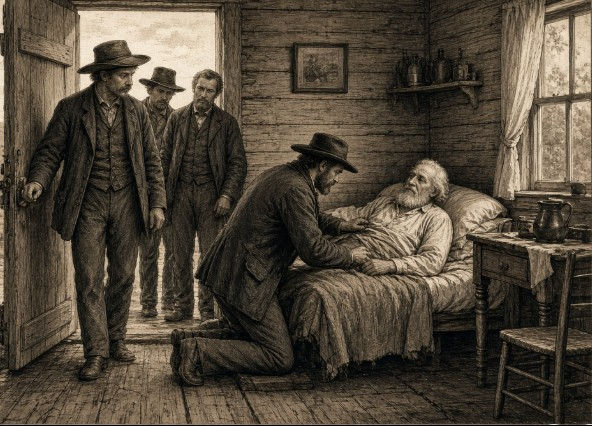
Descendant notes preserved on his Find a Grave memorial align with the papers: he was shot and robbed for his money in his home, found alive the next morning, and died later that day. The perpetrators were never identified.
Isom Ritchie was buried in an unmarked grave at Yale Cemetery in Oark, Johnson County, just across the county line. The cemetery sits on the bank of the Mulberry River west of Oark, adjacent to the historic Yale Church. It is fenced and maintained, yet still contains a number of unmarked, unreadable, or broken stones--common in rural Ozark burial grounds of that era.
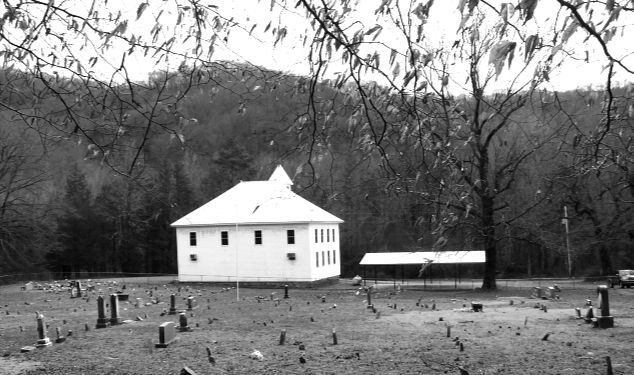
Several other Ritchies, including his son Miles Henry Ritchie, are also interred there.
His widow Martha lived until 1918 or 1919. Several of their children--among them Gabriel “Hawkeye” Ritchie, Henry Crockett “Huey” Ritchie, James Monroe Ritchie, Miles Henry Ritchie, and Solomon B. Ritchie--remained in the region or nearby for years afterward.
No surviving court records, arrest warrants, or later investigations have surfaced in available sources. In the rural Ozarks of 1889, with limited law enforcement, rough terrain, and sparse communication, many such robberies and killings simply went cold.
For more than a century, the story lived mainly in family memory and the brief newspaper clippings transcribed by local researchers. Today it stands as one of Madison County’s oldest documented unsolved murder--an ordinary farmer’s violent end that left no named suspects, no recovered loot, and no resolution.
The hills and hollows around Dutton have kept their silence for nearly 137 years.
Whoever pulled the trigger and took Isom Solomon Ritchie’s money walked away into the same dark evening and was never brought to account.