Cold Case Files: Rumors, speculation, and frustration have been the central driving force in decades-long mystery


On a crisp October day in 1994, a gruesome discovery shooka small community near the Arkansas-Oklahoma state line.
Two miles south of Dora, at the intersection of Interstate 40 and U.S. Hwy. 64D, the mutilated remains of an unidentified woman were found, her body wrapped meticulously in landscaping material and bound with twine. Her decapitated head lay eight feet away, and a gaping 4" x 8" wound in her chest revealed a chilling detail: her heart and left lung were missing.
This horrific crime, uncovered on October 23, 1994, remains one of the most haunting unsolved cases in Sequoyah County if not the region..

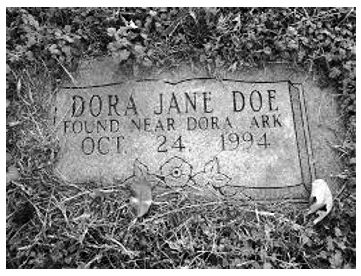
The woman, never identified, was laid to rest in Roland Cemetery on Mayfield Road and given the name "Dora Doe."
Thirty-one years later, her identity and the identity of her killer remain elusive, but the case continues to grip those who seek justice for her.
The discovery of Dora Doe’s body was as meticulous as it was macabre. The careful wrapping of her torso suggested a deliberate attempt to conceal or ritualize the act. Investigators estimated that Dora Doe was approximately 50 years old, 5-foot-3 with a petite build, and had short, dark, graying hair.
A medical examiner determined she was of mixed race, likely Caucasian with possible Asian or American Indian ancestry. Her hair was cropped unusually short, a detail that stood out to those working the case.

The only lead came from witnesses who, 19 days earlier on October 5, 1994, between 4:00 and 4:30 p.m., reported seeing a white male dragging a black bag near the site where Dora’s body was later found.
The man was described as roughly 6 feet tall, with dark brown hair and a mustache, driving a blue 1990s-model Chevrolet Blazer with Arkansas license plates. Despite this description, no suspect was ever identified, and the trail quickly went cold.
For over three decades, investigators have tirelessly combed through missing persons databases across the United States, hoping to match Dora Doe to a name. The list of women ruled out as Dora Doe is extensive, reflecting the exhaustive efforts of law enforcement.

Among those eliminated were Rose Baker (Texas, born 1940), Juanita Bardin (Texas, born 1944), Gloria Berreth (Colorado, born 1956), Ronda Bosquez (Texas, born 1959), Linda Davis (Oklahoma, born 1946), Vivian Elliott (Texas, born 1943), Buffy Harris (Oklahoma, born 1958), Carolyn Harris (Texas, born 1969), Linda Joyce Hefner (Oklahoma, born 1942), Patricia Kelley (Tennessee), Jeanie Lofton (Texas, born 1972), Fae Loo (Alabama, born 1900), Bobbi Parker (Oklahoma, born 1940), Tina Marier Reynolds (Arkansas, born 1967), Tracy Samuels (Oklahoma, born 1968), Patricia Schmidt (Virginia, born 1964), Grace Webber (Oklahoma, born 1900), and Jerry Yell (Oklahoma, born 1940).
Despite these efforts, Dora Doe’s true identity remains a mystery.

In 2010, a potential breakthrough emerged when authorities filed a petition to exhume Dora Doe’s body. The request was spurred by a connection to another murder in the region. In July 1995,
Ruth Henderson was found murdered in her home just outside Fort Smith, Arkansas. Charles Ray Vines, a convicted serial killer, was later found guilty of her murder. A peculiar piece of evidence in Henderson’s case raised questions: a small piece of lung tissue, found lodged in her left ear canal, did not belong to her.
The Arkansas State Police laboratory confirmed it was lung tissue, prompting speculation that it could belong to Dora Doe, whose left lung was missing. If true, this could link Dora Doe to Vines, who was known to target women in the region during the 1990s.
Vines, who died in 2019 while serving a life sentence, was convicted of multiple murders, including the 2000 killing of 16-year-old Katherine Skaggs in Mulberry. His method of operation often involved extreme violence, including mutilation, which aligned with the condition of Dora Doe’s body. However, without DNA evidence to confirm the tissue’s origin, the connection remains speculative.

The 2010 petition to exhume Dora Doe’s body was driven by advances in DNA technology. In January of that year, Courtney Coble, a staff writer for the Sequoyah County Times, reported that an attempt to extract a DNA profile from Dora Doe’s hair samples had failed.
The Oklahoma State Bureau of Investigation (OSBI) hoped that exhuming her remains would yield viable DNA to identify her and potentially link her to the Henderson case. Sequoyah County Sheriff Ron Lockhart confirmed that an order, signed by Associate District Judge A.J. Henshaw, had been issued to exhume the body, but no specific date was set.
Frustratingly, no public announcement ever confirmed whether the exhumation took place. Web searches and posts on platforms like X yield no definitive updates, leaving the status of the exhumation--and any resulting DNA analysis--unclear.
The lack of transparency has fueled speculation among true crime enthusiasts and local residents, many of whom believe the case deserves more attention.
ns a poignant reminder of the challenges in identifying unidentified remains and bringing closure to families. Advances in forensic genealogy, such as those used to identify victims in other cold cases, offer hope.
Organizations like the DNA Doe Project, which has successfully identified dozens of John and Jane Does since 2017, could potentially take on Dora Doe’s case if viable DNA is available. However, without confirmation of the exhumation or successful DNA extraction, her identity remains out of reach.
Looking back, the tragedy of Dora Doe is not just the brutality of her murder but the silence that has followed. Her killer, whether Charles Ray Vines or another predator, has evaded justice for over three decades.
The missing organs, the careful wrapping of her body, and the fleeting sighting of a suspect paint a picture of a calculated crime that demands resolution. If the exhumation order was executed, the public deserves to know the outcome.
Doe is more than a case file. She was someone’s daughter, sister, or friend, and her story is far from over.
If you have information about the Dora Doe case, contact the Sequoyah County Sheriff’s Office or the Oklahoma State Bureau of Investigation.


