Cold Case Files: Nearly 85 years have passed since the mysterious killing of a Haskell County mountain man
- Dennis McCaslin
- 4 minutes ago
- 2 min read


In the remote foothills of the Sans Bois Mountains of Haskell County in the winter of 1941, a shotgun blast ended the life of Walter McDonald inside a lonely mountain shack, leaving behind a puzzle that local officials never solved.
The body was found near noon on February 17. The top of Walter’s head had been torn away by the force of the shot. Little else remained at the scene to explain what had happened. The killer left almost no trace, and an exhaustive search by county officers failed to recover the weapon.
Jake McDonald, Walter’s brother, was forty-two years old and had been staying at the shack. He was not present when the body was discovered. That evening, around seven o’clock, he approached a group of men gathered outside the cabin and was immediately taken into custody by Sheriff Gene England.
Within days, a murder charge was filed. Jake was held without bond in the Haskell County jail. He denied the accusation with force, insisting he had no knowledge of the crime and no part in it.
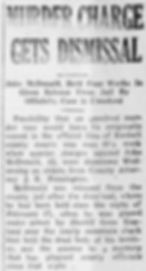
Four weeks later the case collapsed. On orders from County Attorney J. B. Pennington, the murder charge against Jake was dismissed. He walked free from the jail. Officials acknowledged that the evidence was simply too thin to proceed. No murder weapon had been found, no clear motive had been established, and no witness could place Jake at the scene at the moment of the killing.
The possibility that an unsolved murder would remain permanently on the books of the county courts was noted at the time in the local press.
Nothing in the public record shows that the investigation advanced after Jake’s release. No other suspect was ever publicly named. No later arrest, indictment, or confession appears in surviving accounts. Decades passed, the principal figures died, and the file on Walter McDonald’s death stayed closed.
The case became one more entry in the long list of rural Oklahoma homicides that faded without resolution.
Cases of this kind were common in the era. Rural counties operated with limited resources. Forensic science was rudimentary. Fingerprints, ballistics, and blood analysis were available in larger cities but rarely practical or conclusive in isolated mountain country.
Investigators relied heavily on eyewitness accounts, confessions, and physical evidence that could be seen with the naked eye. When a shotgun blast destroyed most of the victim’s head, and the weapon itself vanished into the woods or a creek, the trail often ended.

Local politics, family ties, and the simple absence of proof frequently led prosecutors to drop charges rather than risk a weak case at trial. Many such killings were quietly marked unsolved and left to gather dust.
Walter McDonald’s death fits that pattern exactly. Two brothers shared a remote cabin. One was found dead from a close-range shotgun wound. The other was arrested, held, and then released for lack of evidence. The weapon was never recovered. No one else was charged.
The file was closed. Eighty five years later the question of who fired the shot that killed Walter McDonald in that lonely mountain shack remains unanswered.
