Cold Case Files: Abducted in Tulsa, dumped near Braggs and no movement in case since 2024 Dateline interview


On April 9, 1987, 22-year-old Marilyn Joi Base, known to friends and family as Joi, was abducted from the laundry room of her apartment complex at Pepper Ridge Apartments, located at 12500 E 41st Street in East Tulsa, Oklahoma.
Ten days later, on April 19, 1987, her body was discovered at the bottom of Bragg Mountain in Muskogee County, approximately 30 minutes from Tulsa. The Oklahoma State Bureau of Investigation (OSBI) and Tulsa Police Department (TPD) continue to investigate this case, which remains unsolved after nearly 38 years.
Marilyn Joi Base was last seen around 9:00 p.m. on April 9, 1987, when she left her apartment to do laundry at the complex’s laundry room. She drove her vehicle to the facility, leaving barefoot, and was reported missing by her boyfriend around 10:30 p.m. when she failed to return after an hour. H
er boyfriend found her car parked outside the laundry room with the keys still in the ignition and her laundry basket in the front seat. Her clothes remained in the washing machine, indicating she may not have made it inside the laundry room before her abduction.
No witnesses to the abduction have been identified, though an anonymous tip from an unidentified woman provided some early leads.
The tipster claimed to have seen Marilyn abducted from the parking lot and described the suspect’s vehicle, though she refused to provide her name. She also stated she had drawn a sketch of the suspect and left it in a phone booth near the apartment complex.

However, Tulsa police later reported that the sketch did not significantly aid the investigation.
The lack of concrete evidence from this tip and the absence of follow-up information have hindered progress in identifying a suspect.
On April 19, 1987, authorities received an anonymous tip about a body at a scenic overlook off Highway 10 on Bragg Mountain in Muskogee County, near the Arkansas River and approximately five miles north of Braggs.
The area is close to Camp Gruber, a training facility for the Oklahoma Army National Guard.
Marilyn’s body was found naked and badly decomposed, making it difficult to determine the exact time of death. An autopsy revealed she had been strangled with a ligature, and there were indications she may have been sexually assaulted, though decomposition limited the extent of forensic findings.
The condition of the body suggested she had been dead for some time, possibly killed shortly after her abduction and dumped later, though investigators have not ruled out the possibility that she was held captive before her death.
The Tulsa Police Department initially handled the investigation into Marilyn’s disappearance, but the case was later transferred to the OSBI, which remains the primary investigating agency.
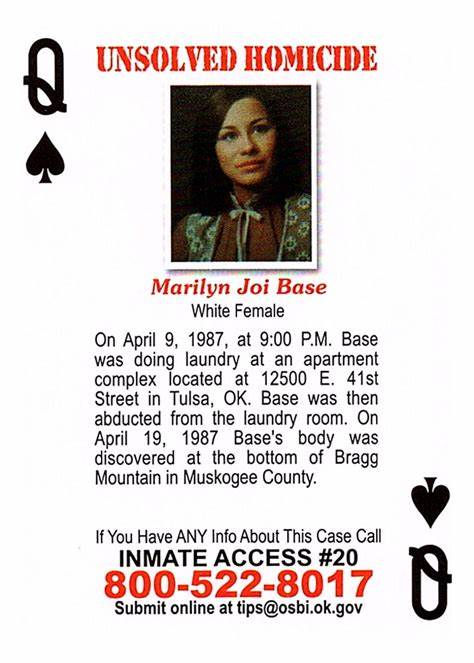
Lieutenant Brandon Watkins of the TPD noted in a 2024 interview with Dateline that the department’s documentation on the case is sparse, limiting their ability to provide detailed insights. The OSBI has classified the case as active and ongoing, with Public Information Manager Hunter McKee stating in 2024 that the agency would share any new developments as they arise.
In 2023, the OSBI highlighted Marilyn’s case on the 36th anniversary of her abduction via a Facebook post, urging the public to come forward with tips and stating, “Someone out there knows something about this case.”
The case has also been featured in the OSBI’s Cold Case Playing Cards program, an initiative designed to generate leads by distributing decks of cards featuring unsolved cases to inmates in Oklahoma correctional facilities. Marilyn is represented as the Queen of Spades in the deck, which is also available for public viewing on the OSBI website.

Marilyn Joi Base, born Marilyn Joi Bowker, grew up in Broken Arrow, just outside Tulsa. Described by her childhood best friend, Charlotte Autry, as a “gentle spirit” and a “joy,” Marilyn was known for her love of simple pleasures, such as swinging on a rope over a ditch in her family’s backyard, playing with horses, and singing in church.
She had been married and divorced prior to her death, and was living at the Pepper Ridge Apartments at the time of her abduction. Her immediate family has since passed away, leaving Charlotte Autry as one of the primary advocates for justice in her case.
Charlotte learned of Marilyn’s disappearance through news reports, initially not recognizing her friend due to the use of her married name, Base, rather than her maiden name, Bowker. It was Charlotte’s mother who connected the missing person report to Marilyn.
Charlotte has remained committed to keeping Marilyn’s memory alive, regularly visiting her grave and speaking to media outlets like Dateline and News on 6 to encourage new leads. “There’s got to be an answer,” Charlotte told Dateline in 2024. “There’s got to be some kind of justice.”
Marilyn’s case is one of several unsolved crimes against women in the Tulsa area during the late 1980s, including the cases of Francine Frost, Christine Miller, and Michelle Hagemeister, among others.
While there is no evidence linking these cases, the prevalence of unsolved abductions and murders in the region has led to speculation about the possibility of a serial offender, though no official theory has been confirmed.
The rural and isolated location where Marilyn’s body was found, combined with the 50-mile distance from Tulsa to Bragg Mountain, suggests the perpetrator may have had some familiarity with the area, possibly using Highway 10 or Interstate 40 to transport the body.
The investigation has faced significant challenges, including the lack of witnesses, limited physical evidence due to decomposition, and the inability to locate the anonymous tipster who provided the sketch.

Advances in DNA technology have helped solve other Oklahoma cold cases, such as the 1985 murder of Paul Aikman and a series of Muskogee sexual assaults from the 1990s, but no such breakthroughs have been reported in Marilyn’s case.
The OSBI continues to explore forensic genealogy and other modern techniques, but the absence of new leads remains a barrier.
As of April 2025, Marilyn Joi Base’s murder remains an open cold case.
The agency’s Cold Case Unit, established in 2018, has successfully resolved other cases using DNA and genealogical analysis, raising hope that similar methods could eventually provide answers in Marilyn’s case.
Charlotte Autry continues to advocate for her friend, emphasizing the need for closure and justice.
The OSBI encourages anyone with information to contact them at cold.case@osbi.ok.gov or by calling 1-800-522-8017.


